



Management
●
June 30, 2026
●
8 min reading
AGM Meeting Minutes : a Guide with Template
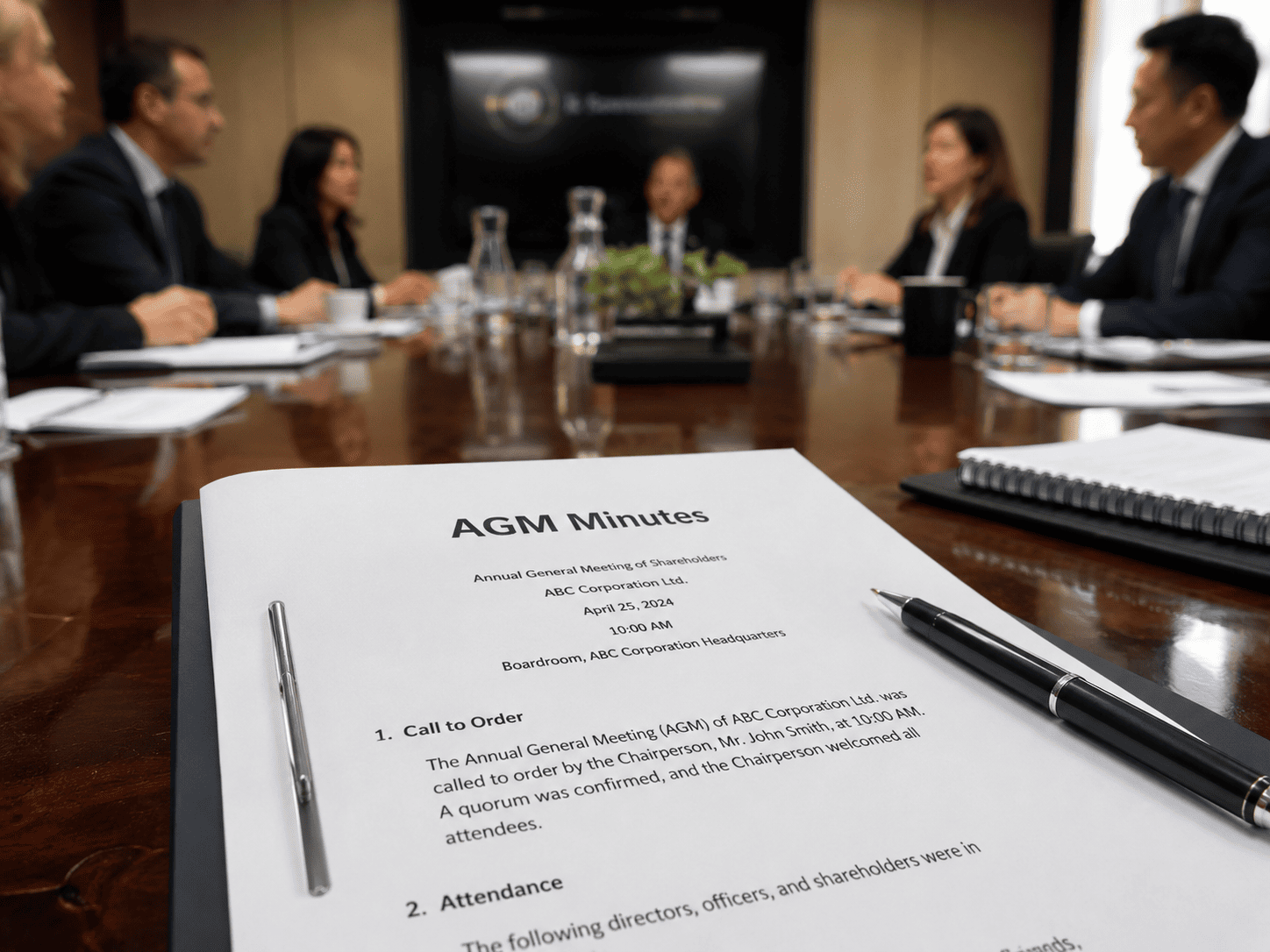
AGM minute are the official record of your meeting and an important part of your organization’s governance.
In this guide, you’ll see what to include in your AGM minutes template with a template.
The Importance of AGM Minutes
AGM meeting minutes summarize the key proceedings of your Annual General Meeting. They usually record who attended, whether quorum was reached, which reports were presented, what resolutions were proposed, how votes were decided, and what actions need to happen next.
Depending on your country, legal structure, and governing documents, AGM minutes may be be required.
For example, UK Companies House guidance says companies must keep minutes of general meetings and records of member resolutions for 10 years. Those records must also be available for member inspection on request.
Your own rules may be different. A company, charity, club, association, cooperative, or nonprofit may all have different obligations.
Before finalizing your AGM minutes, check your articles of association, bylaws, constitution, charity rules, company law, or local regulations.
With clear AGM minutes, you can:
- Prove that the AGM was held
- Confirm who attended the meeting
- Show whether quorum was reached
- Record reports from the chair, treasurer, directors, or committees
- Document resolutions and voting results
- Track appointments, elections, or resignations
- Capture member questions and official responses
- Record action items and responsibilities
- Keep evidence for audits, governance reviews, or legal checks
AGM Meeting Minutes Template
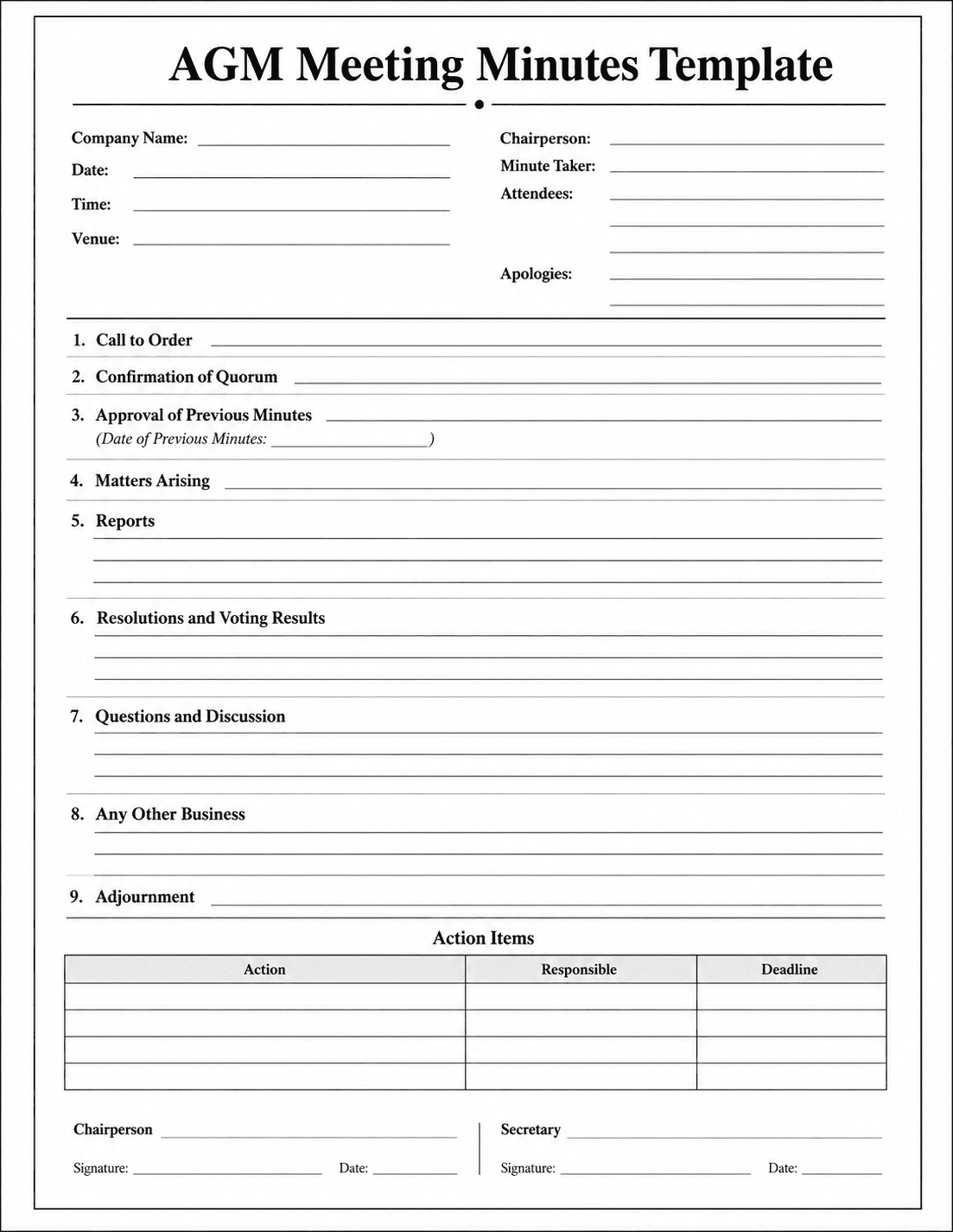
Writing AGM minutes is much easier when you start with a clear structure.
Use the template below as a starting point.
Organization name: [Insert organization name]
Meeting type: Annual General Meeting
Date: [Insert date]
Time: [Insert start time]
Location: [Insert physical location or video meeting link]
Chairperson: [Insert name]
Minute taker / Secretary: [Insert name]
1. Attendance
Present:
[List members, shareholders, directors, trustees, committee members, or attendees present]
Apologies:
[List people who sent apologies]
Guests or observers:
[List guests, advisors, auditors, legal representatives, or observers]
Proxies received:
[List proxy votes received, if applicable]
Quorum:
The Chair confirmed that a quorum was [present / not present] in accordance with the organization’s governing documents.
2. Opening of the Meeting
The Chair opened the Annual General Meeting at [insert time].
The Chair welcomed attendees and confirmed that notice of the meeting had been given in accordance with the organization’s rules.
The Chair confirmed that the meeting was validly convened and able to proceed.
3. Approval of Previous AGM Minutes
The minutes of the previous Annual General Meeting held on [insert date] were presented for approval.
Motion: That the minutes of the previous AGM be approved as a true and accurate record.
Proposed by: [Insert name]
Seconded by: [Insert name]
Result: [Approved / Approved with amendments / Not approved]
Amendments requested:
[Insert amendments, or write “None”]
4. Chairperson’s Report
The Chair presented the annual report.
Key points noted:
- [Insert main achievement]
- [Insert main challenge]
- [Insert strategic update]
- [Insert important member or shareholder communication]
Questions raised:
[Summarize key questions and responses]
The report was [received / approved / noted].
5. Financial Report
The Treasurer, Finance Director, or appointed representative presented the financial report for the year ending [insert financial year end date].
Key points noted:
- [Insert revenue or funding update]
- [Insert expense or budget update]
- [Insert surplus, deficit, profit, or loss]
- [Insert audit or accounting update]
- [Insert financial risks or priorities]
Motion: That the financial statements be received and approved.
Proposed by: [Insert name]
Seconded by: [Insert name]
Result: [Approved / Not approved / Deferred]
Questions raised:
[Summarize key financial questions and responses]
6. Elections and Appointments
The meeting considered elections and appointments for the following positions:
Position: [Insert role]
Nominee: [Insert name]
Result: [Elected / Re-elected / Not elected / Deferred]
Position: [Insert role]
Nominee: [Insert name]
Result: [Elected / Re-elected / Not elected / Deferred]
The meeting also confirmed the appointment of [auditor / accountant / officer / committee member] for [insert period], if applicable.
7. Resolutions and Voting
The following resolutions were presented to the meeting.
Resolution 1: [Insert resolution title]
Wording of resolution:
“[Insert exact wording of the resolution]”
Proposed by: [Insert name]
Seconded by: [Insert name]
Voting method: [Show of hands / ballot / poll / proxy / electronic vote]
Votes for: [Insert number]
Votes against: [Insert number]
Abstentions: [Insert number]
Result: [Passed / Failed]
Resolution 2: [Insert resolution title]
Wording of resolution:
“[Insert exact wording of the resolution]”
Proposed by: [Insert name]
Seconded by: [Insert name]
Voting method: [Insert method]
Votes for: [Insert number]
Votes against: [Insert number]
Abstentions: [Insert number]
Result: [Passed / Failed]
8. Member Questions and Discussion
The following questions or comments were raised by members, shareholders, or attendees:
- Question / comment: [Insert summary]
Response: [Insert response] - Question / comment: [Insert summary]
Response: [Insert response]
Keep this section neutral. Record the main point and response, not every word of the discussion.
9. Action Items
Action itemOwnerDeadlineRelated agenda item[Insert task][Insert name][Insert date][Insert item][Insert task][Insert name][Insert date][Insert item][Insert task][Insert name][Insert date][Insert item]
10. Any Other Business
The following additional matters were raised:
- [Insert item]
- [Insert item]
- [Insert item]
No further business was raised.
11. Closing of the Meeting
The Chair thanked attendees for their participation.
The meeting was closed at [insert time].
Date of next meeting: [Insert date, if known]
12. Approval and Signature
These minutes were approved as a true and accurate record of the Annual General Meeting.
Approved by: [Insert name]
Role: [Chairperson / Secretary / Board member]
Date approved: [Insert date]
Signature: ______________________
Before you use this template, adapt it to your organization. Some AGMs need proxy details, special resolution wording, audit notes, regulatory filings, or more formal voting records.
The best AGM minutes are clear, neutral, and easy to verify. They should help your organization prove what happened, remember what was decided, and act on the next steps.
AI AGM Meeting Minutes: Noota
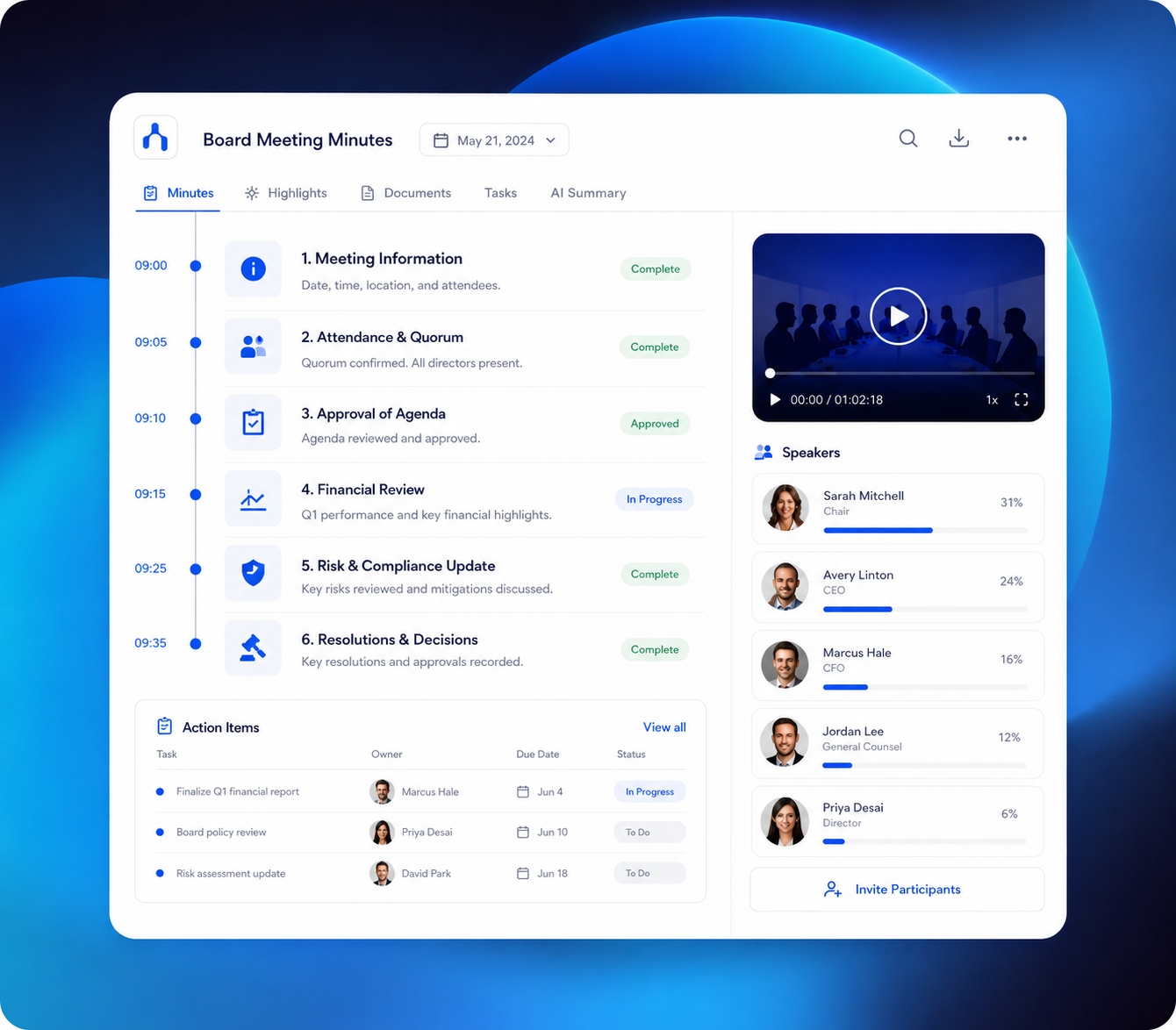
AGM minutes are important, but writing them manually can be stressful.
Noota helps you make the process easier.
- Real-Time Recording and Transcription : Noota records the meeting and transcribes the conversation as it happens. This eliminates the need to take notes manually or rely on memory.
- Smart Templates for AGM Minutes : Noota provides customizable templates tailored to forma AGM meetings.
- One-Click Sharing : After the meeting, minutes can be reviewed, finalized, and shared instantly.
Send a summary to board members, stakeholders, or compliance teams with just one click. - Secure Storage and Compliance : Noota stores transcripts and minutes securely in the cloud.
Only authorized users can access sensitive discussions. - Searchable Meeting History : Need to revisit a decision made three months ago? Noota makes every meeting fully searchable. This is a major advantage for board secretaries and legal teams handling recurring reviews.
Use Noota AI AGM minutes for free here
FAQ
What are AGM meeting minutes?
AGM meeting minutes are the official written record of an Annual General Meeting. They summarize what happened, who attended, what was discussed, what was approved, and what actions need to happen next.
They are not a word-for-word transcript. Their goal is to create a clear record of the meeting’s main proceedings and decisions.
What should AGM minutes include?
Your AGM minutes should include the essential details of the meeting.
At minimum, you should usually record:
- Organization name
- Date, time, and location
- Chairperson and minute taker
- Attendees and apologies
- Confirmation of quorum
- Approval of previous minutes
- Reports presented
- Resolutions proposed
- Voting results
- Elections or appointments
- Questions raised
- Action items
- Closing time
- Approval and signature
Your final structure may depend on your organization’s rules, bylaws, articles, or constitution.
Are AGM minutes legally required?
In many organizations, yes. But the exact rules depend on your country, legal structure, and governing documents.
For example, companies, charities, nonprofits, associations, and cooperatives may all follow different recordkeeping rules. That is why you should always check your local legislation and your organization’s governing document before finalizing your minutes.
Do AGM minutes need to include every discussion?
No. AGM minutes should not include every sentence spoken during the meeting.
They should focus on the main proceedings, decisions, resolutions, votes, and follow-up actions. You can summarize discussion points, but avoid unnecessary detail or personal commentary.
A good rule is simple: record what matters for governance, accountability, and future reference.
Who writes AGM meeting minutes?
AGM minutes are usually written by the secretary, minute taker, company secretary, board administrator, or another person appointed before the meeting.
The important thing is that someone is clearly responsible. If nobody owns the minutes, important details can get missed.
Before the AGM starts, confirm who will take notes, who will check the draft, and who will approve the final version.
Who approves AGM minutes?
AGM minutes are usually reviewed and approved by the chairperson, secretary, board, committee, members, or shareholders, depending on your organization’s rules.
Some organizations approve the minutes at the next AGM. Others review them sooner at a board or committee meeting.
Your approval process should match your governing documents.
How long should AGM minutes be kept?
Retention rules depend on your jurisdiction and organization type. Some organizations are required to keep meeting minutes and resolution records for a set number of years.
Even when the rules are not clear, you should store AGM minutes securely and make them easy to find later. They may be needed for audits, legal checks, member questions, or future governance reviews.
Can AI help write AGM minutes?
Yes. AI can help you create a first draft of your AGM minutes from a recording or transcript.
With a tool like Noota, you can record the AGM, transcribe the discussion, and generate structured notes with decisions, action items, and key takeaways.
But AI should not be the final reviewer. Your team should still check names, attendance, quorum, resolutions, voting results, and any legally required wording before approval.
What is the best way to prepare AGM minutes?
The best way is to start before the meeting.
Prepare your agenda, use an AGM minutes template, confirm the minute taker, and decide how votes and resolutions will be recorded. Then review the draft soon after the meeting while the details are still fresh.
If you want to save time, use Noota to capture the full conversation and generate a structured draft. You can then edit it into formal minutes your organization can approve.
Meet the Writer

Jean-marc is an AI expert helping recruiters & professionnals leverage these tools in their everyday work processes.