


Interview Questions & Techniques
8 min reading
Updated on:
Feb 11, 2026
STAR Interview Method for Recruiters : a Guide
Do you want to know what STAR interviews are ? Here's your guide.

Unstructured interviews make it hard to compare candidates and even harder to justify decisions.
This is exactly why the STAR interview method exists.
In this article, you’ll learn what the STAR interview method really is from a recruiter’s perspective and the best STAR questions.
What is a STAR interview
At its core, STAR is a structured way of answering interview questions recommended for candidates. But it can also be leveraged by recruiters to structure their interview questions.
STAR stands for :
- Situation: the context or background of a real work scenario.
- Task: what the candidate was trying to achieve.
- Action: the specific steps they took.
- Result: the outcome or impact of those actions.
The origin of this technique can be traced back to Tom Janz, a Canadian psychologist and human resources instructor.
He had a simple but powerful idea: if a candidate has developed certain skills in a previous job, it means they are well placed to successfully reuse them. This led him to invent a behavioral framework (STAR) to predict a candidate's future performance based on their past experiences.
Benefits of the STAR interview structure

When you shift from traditional, free-form interviews to the STAR interview method, you’re fundamentally improving how you evaluate talent.
1. STAR improves prediction of future success
One of the strongest arguments for structured behavioral interviews like STAR is predictive validity : the degree to which interview results forecast on-the-job performance. Studies show that structured behavioral interviews focused on past behavior are far better predictors of future success than unstructured conversations. That’s because past behavior in real situations is strongly linked to how candidates will perform in similar future tasks.
STAR’s focus on concrete scenarios forces candidates to recall actual work experience rather than speculate. When someone details what they’ve done — rather than what they think they would do — you get real evidence of their capabilities.
2. STAR brings structure — and structure reduces bias
Structured interviewing methods like STAR help reduce common sources of bias. When every candidate is asked similar questions using the same STAR format, it becomes easier to compare apples to apples.
3. STAR helps you assess competencies clearly
STAR questions concentrate on real-world examples that show a candidate’s skills in action — not just on what their CV says. By structuring responses around Situation, Task, Action, and Result, you’re more likely to uncover:
- how they actually solved problems under pressure
- how they made decisions in real work contexts
- how they handled team dynamics or conflict
- whether they drove results, and what those results looked like
4. STAR improves candidate experience
STAR improves the interview experience for candidates too. Because the structure signals clarity and fairness, candidates know what kind of responses you’re looking for, which reduces anxiety and makes them more likely to share meaningful examples.
5. STAR supports stronger decision-making and alignment
Because STAR answers are standardized, they’re easy to turn into structured notes, scorecards, and hiring meeting discussions. Instead of debating impressions like “I just liked them” or “They seemed confident”, you discuss behavior and results.
For example, you can compare how two candidates approached a similar type of challenge — what actions they took and what results they generated — which leads to more transparent, defensible hiring decisions.
Best STAR interview questions to ask

There are first foundational prompts that give you clear evidence of how candidates behave in real work scenarios:
- “Tell me about a time you solved a difficult problem at work.”
This shows problem-solving and initiative. - “Describe a situation where you had to work under pressure.”
You learn how they manage stress and priorities. - “Give an example of when you had a conflict with a team member and how you resolved it.”
This touches on teamwork and interpersonal skills. - “Tell me about a time you had to adapt to a major change at work.”
Adaptability and resilience become clear.
Competency-focused STAR questions
To assess specific skills, tailor questions to the competencies most important for a role:
Leadership & teamwork
- “Describe a situation when you led a team through change.”
- “Give an example of motivating others toward a shared goal.”
These reveal leadership behavior and influence.
Communication
- “Tell me about a time you had to explain a complex idea clearly.”
- “Describe when you had to persuade someone to change their view.”
These questions uncover clarity, diplomacy, and impact.
Decision-making & problem solving
- “Describe a time you had to make a tough decision with limited info.”
- “Give an example of using data to make a recommendation.”
Here you learn logic and analytical ability.
Achievement & initiative
- “Tell me about the project you’re most proud of and why.”
- “Give an example of when you went above and beyond expectations.”
These highlight drive and ownership.
Questions for more nuanced assessment
Some STAR prompts dig deeper, helping you see how candidates learn and grow, not just perform:
- “Tell me about a time you failed — what did you learn?”
Insight into humility and improvement. - “Describe a time when you had to prioritize conflicting demands.”
This reveals judgment and planning skills. - “Give an example of handling a difficult customer or client.”
Shows service mindset and conflict management.
STAR interview automation : Noota

Instead of manually tracking STAR answers, and later piecing them together, you can automate much of it. That's what Noota does :
Record, transcribe, and capture responses automatically
One of the biggest challenges in structured interviews is staying present while capturing details. When you’re typing or scribbling, you lose eye contact and miss nuances. Noota solves that by automatically recording and transcribing interviews in real time, whether you’re on Zoom, Teams, Meet, or in person.
Structured summaries and objective evaluation
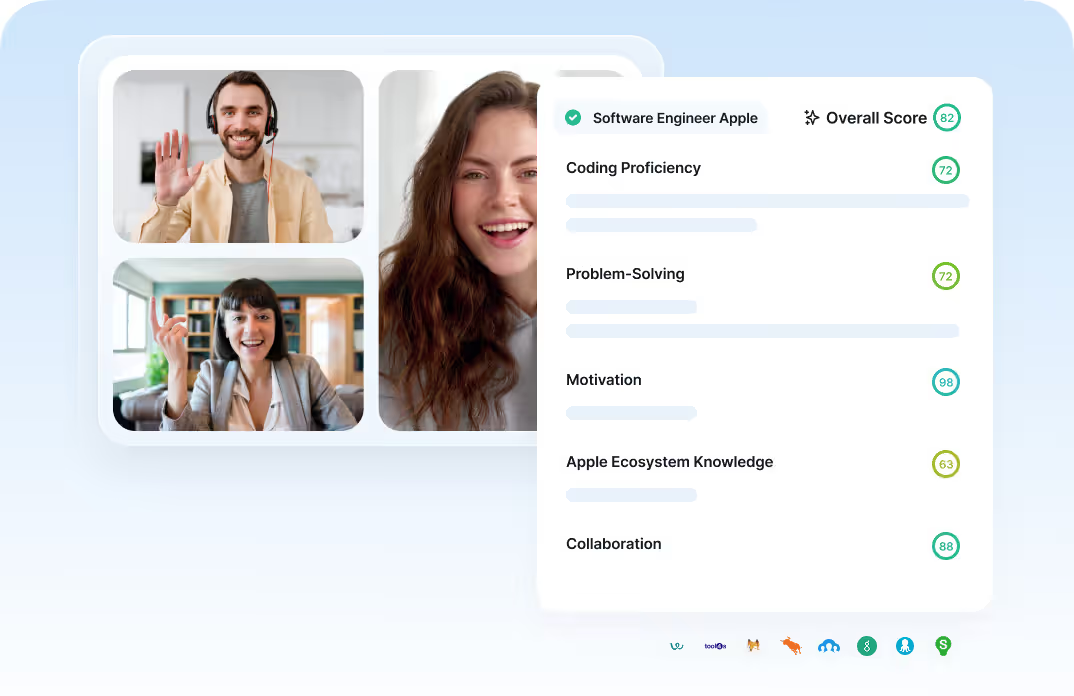
After the interview ends, most recruiters still face a pile of notes or half-remembered responses. Noota goes further: it generates concise, structured summaries that highlight candidate takeaways, strengths, and areas for improvement — all framed around key interview responses. That makes it far easier to compare candidates side by side and see who really delivered evidence against your STAR questions.
Guidance & consistency during interviews
Even with STAR, interviewers can accidentally skip a key part of a candidate’s response in the flow of conversation. Noota includes interview guidelines and reminders so you cover what matters most. It prompts you to ask core questions and helps you maintain the structured flow that STAR demands.
Better decision-making with rich context and ATS integration
After multiple interviews, you often need to share insights with hiring managers or other stakeholders. Noota’s structured output and ATS integration mean you can sync STAR-based summaries, transcripts, and scorecards directly into your hiring systems
TRY NOOTA FOR FREE NOW
STAR Interview FAQ
1. Does STAR work for every role?
Yes — STAR is useful across levels and functions because it’s based on real behavior, which is one of the strongest predictors of future performance. Structured behavioral interviewing like STAR helps you evaluate how a candidate actually handled situations, making it relevant whether you’re hiring for junior, mid-level, or senior roles.
For technical or highly specialized roles, combine STAR questions with technical assessments or simulations that measure domain knowledge directly.
2. How many STAR questions should I ask?
A typical structured interview uses around 5–8 STAR questions tailored to the key competencies you care about.
Too few and you risk gaps in evaluation; too many and you risk overwhelming the candidate or your interview panel.
Start with:
- 2–3 core questions (leadership, teamwork, problem solving)
- 2–3 competency-specific questions (based on the role’s priorities)
- 1–2 situational or learning-oriented questions
This gives you a balanced view while keeping the interview focused.
3. Should I tell candidates to answer in STAR format?
You can explain the STAR structure briefly at the start of the interview, especially if you want responses that are highly organized and comparable.
Being transparent helps candidates give complete, concise examples by guiding them on how you expect their answers to be structured.
However, you don’t have to label the acronym explicitly — often, well-phrased questions naturally lead candidates into a STAR response if you follow up with probes like:
- “What exactly did you do next?”
- “What was the measurable outcome?”
These help if candidates skip parts of the STAR flow.
4. What’s the biggest mistake recruiters make with STAR?
A common trap is accepting incomplete stories. Candidates sometimes describe the situation and task well, but skimp on their actions or weave vague “we did” responses that don’t highlight individual contributions.
Good follow-ups matter. If a candidate glosses over their own contribution, ask:
- “What part did you play in that outcome?”
- “What specific steps did you take?”
This keeps the answer focused on individual action and result rather than team achievements at large.
5. Can STAR replace other interview techniques?
No — STAR is one component of a well-rounded hiring process. It’s excellent for behavioral and competency evaluation, but you’ll often combine it with:
- Technical or role-specific assessments
- Case studies or work samples
- Culture fit or values-based questions
Together, these tools help you evaluate both how someone performs and how they’ll perform in context.
6. How do I score STAR responses consistently?
Use structured scorecards that map each STAR component to desired competencies.
For each competency (e.g., problem solving), define what excellent looks like versus satisfactory or needs improvement. This turns subjective impressions like “friendly” or “confident” into objective evidence tied to results and actions.
7. What should I do if a candidate can’t think of an example?
Gently guide with alternative prompts. Sometimes the first question is too broad or not relevant to their experience. Try:
- “Tell me about a time you handled a difficult customer.”
- “Describe a time you learnt something new quickly.”
These often elicit specific examples that fit STAR and still reveal meaningful behavior.
8. Does STAR help reduce bias?
Yes — STAR’s structured format helps level the playing field. When every candidate answers the same types of evidence-based questions and you score the four STAR components consistently, you reduce reliance on gut impressions or interview “vibes” and increase fairness across candidates.
Meet the Writer

FAQ
STAR creates consistency by asking every candidate similar questions in the same format, enabling fair apples-to-apples comparisons.
- Standardized questions minimize subjective evaluation differences.
- Structured format focuses on concrete examples over impressions.
- Consistent scoring criteria remove personal preference influence.
STAR's predictive validity comes from examining past behavior in real situations, which strongly correlates with future performance in similar tasks.
- Candidates recall actual experiences rather than hypothetical responses.
- Concrete scenarios reveal genuine problem-solving capabilities.
- Real work context provides stronger performance indicators than speculation.
STAR interviews are effective but time-intensive. Noota automates interview documentation and analysis, saving 6.4 hours weekly while maintaining STAR's structured approach with 80% less admin work.
- Noota records, transcribes, and summarizes STAR responses automatically.
- Reduces manual note-taking that slows traditional STAR interviews.
- Trusted by 5000+ teams with 4.9/5 G2 rating for reliability.
Noota combines STAR methodology with automation, enabling teams to conduct structured behavioral interviews at scale without sacrificing quality or fairness.
- Supports 80+ languages for global hiring consistency.
- Standardizes STAR evaluation across multiple interviewers.
- Frees recruiters from admin to focus on candidate assessment.
Try Noota free — no credit card needed.