


Interview Questions & Techniques
8 min reading
Updated on:
Jan 13, 2026
What's a good Interview to hire ratio
You want to know what interview to hire ratio is and how to improve it ? Here's your guide.
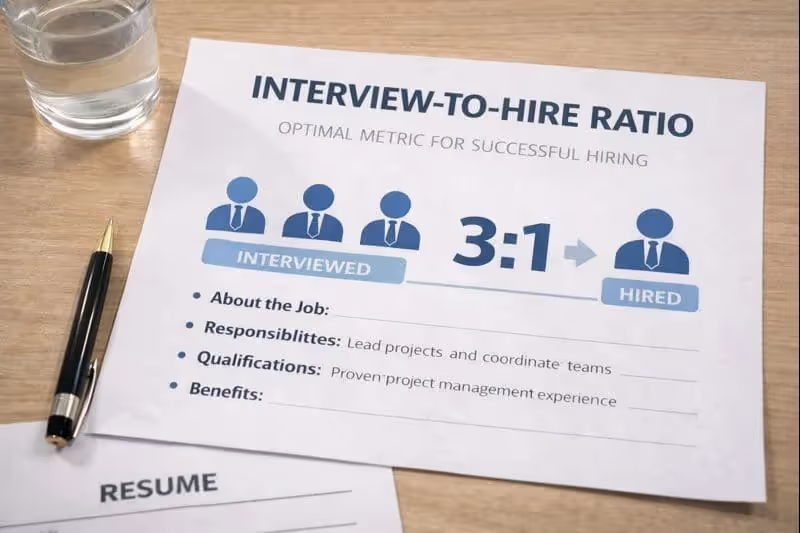
Are you conducting too many interviews with too few hires to show for it? That’s the exact question your interview to hire ratio helps answer.
In this article, we’ll walk you through what the interview to hire ratio really means, where you should aim for compared with common benchmarks, and practical ways to improve it.
What Is an Interview to Hire Ratio?
At its core, the interview to hire ratio is a recruitment metric used to understand how many interviews are needed to make a successful hire over a specific period.
To calculate it, simply divide the total number of interviews conducted by the number of hires made in that same timeframe. For example, if your team conducts 50 interviews and hires 5 people, your interview to hire ratio is 10:1 — meaning you needed 10 interviews to make one hire.
This metric sits alongside other HR measurements like the interview-to-offer ratio (which tracks interviews needed to make an offer) and applicant-to-interview ratio (which tells you how many applicants make it to the interview stage). Together, these metrics help you understand different parts of your recruitment funnel.
What’s a Good Interview to Hire Ratio?
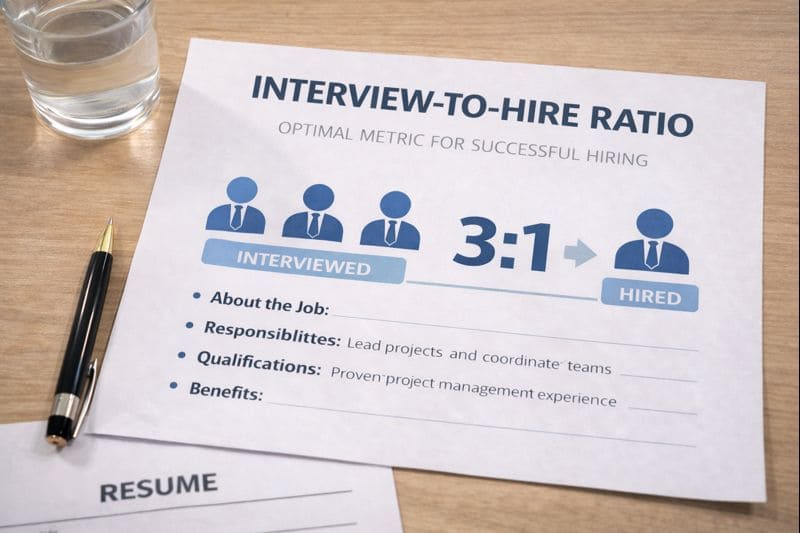
A commonly suggested target for a healthy interview to hire ratio is around 3:1. This means you’d typically interview three candidates for every one hire, which suggests your screening and interviews are focused and efficient.
In pratice the average interview to hire ratios closer to 8:1 to 10:1 in many organizations — meaning eight to ten interviews lead to one hire — especially when roles are more competitive or require multiple rounds of evaluation. A ratio in that range can still be perfectly valid; it might simply reflect a wider candidate pool or a meticulous assessment process.
Best Practices to Improve Your Interview Ratio
Improving your interview to hire ratio means streamlining your hiring process so you interview better, not just fewer.
Refine Your Job Descriptions
Before you even start interviewing, take a hard look at your job descriptions. A vague or overly broad job post attracts a wide range of applicants — many of whom won’t match the role’s requirements. Clear, specific descriptions help attract candidates who already meet your must-have skills and experience, meaning you’ll spend less time interviewing people who aren’t a fit. Tailor requirements to reflect real responsibilities, and be explicit about expectations so candidates can self-select before applying.
Strengthen Pre-Screening and Sourcing
An effective pre-screening system filters out unqualified candidates before you schedule interviews. Use tools like tailored questionnaires, phone screens, or skills assessments to evaluate basic fit early in the process.
On the sourcing side, focus on channels that consistently deliver quality applicants — employee referrals, targeted job boards, and niche communities often outperform generic posting sites.
Standardize Your Interview Process
Consistency counts. When each candidate experiences the same interview stages and questions, you reduce bias and make better comparisons across interviews. Structured interviews with defined question sets and scoring rubrics help you assess candidates on job-relevant criteria instead of impressions. This reduces the number of inconclusive interviews and helps you identify great fits more reliably.
Train Your Interviewers
Your interviewers shape the interview experience and hiring decisions. Training interviewers on effective questioning, bias awareness, and how to evaluate answers objectively can make a big difference. When interviewers understand what you’re looking for and how to rate responses consistently, you avoid unnecessary follow-up interviews caused by inconsistent evaluation.
Better Recruitment Decisions: Noota
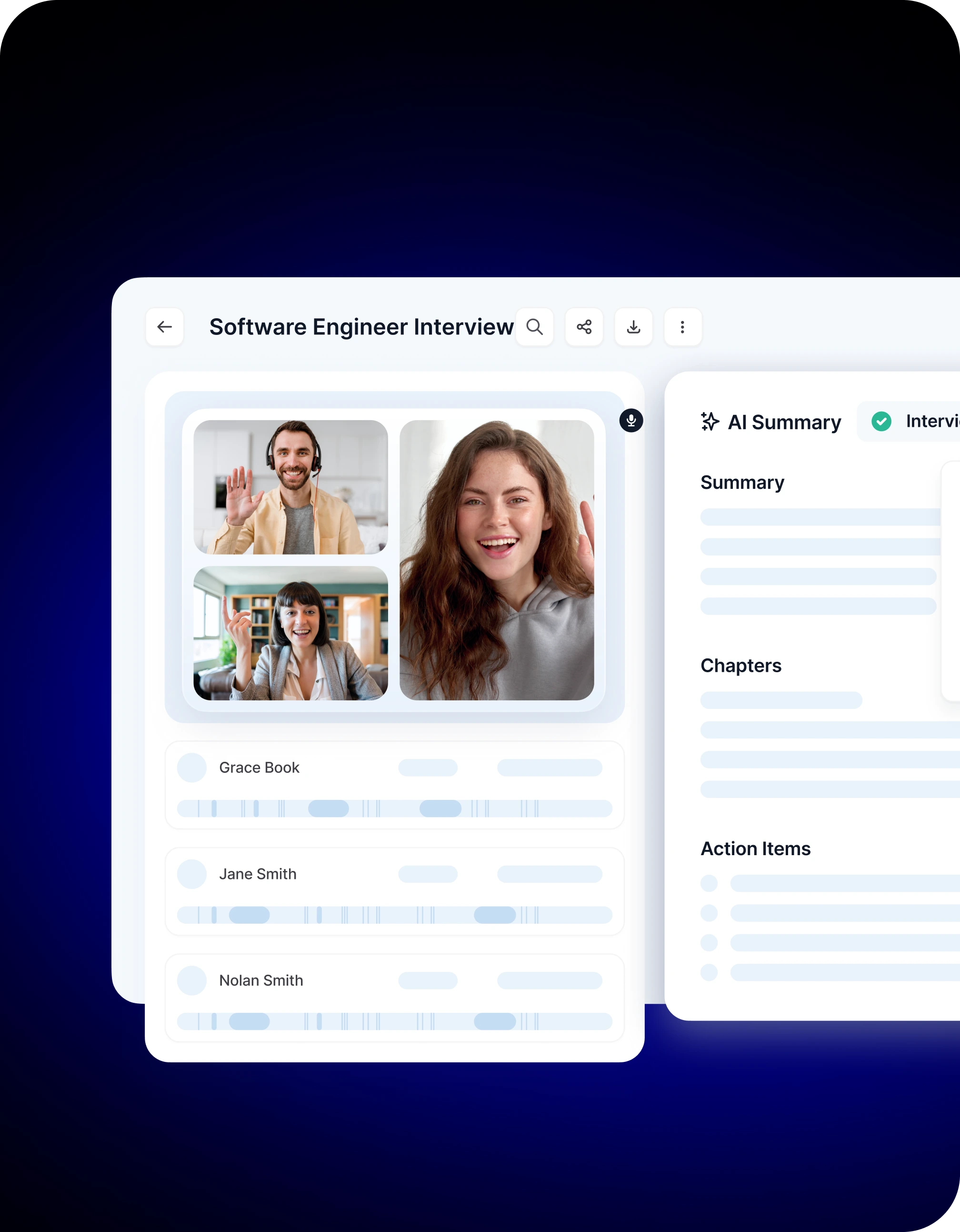
Noota captures every interview detail and turns it into structured information you can use confidently when deciding whom to hire.
- Automatic Interview Transcriptions: Every conversation is recorded and transcribed, so you never miss a key point. This ensures your hiring decisions are grounded in what candidates actually said, not what you think you remember.
- Structured Candidate Reports: Noota organizes interview content into concise summaries and scorecards that highlight strengths and areas of concern. This clarity helps your team compare candidates objectively and consistently.
- Real-Time Insights and Collaboration: Teams can review the same structured insights together, which reduces back-and-forth and speeds up consensus. You avoid duplicate interviews simply because you lacked a clear record of past assessments.
Want to the best insights to hire the right candidate ? Try Noota for free now
Meet the Writer

FAQ
A healthy interview to hire ratio typically targets around 3:1, meaning three interviews per hire. However, many organizations average 8:1 to 10:1, which is still valid depending on role competitiveness and evaluation rigor.
- 3:1 ratio indicates focused, efficient screening
- 8:1 to 10:1 reflects thorough assessment processes
- Your target depends on industry and hiring complexity
Divide total interviews conducted by number of hires made in the same timeframe. For example, 50 interviews ÷ 5 hires = 10:1 ratio, meaning ten interviews were needed per successful hire.
- Track interviews and hires over consistent periods
- Compare ratios monthly or quarterly for trends
- Use this metric alongside applicant-to-interview ratios
Yes. Noota automatically records, transcribes, and summarizes interviews in 80+ languages, helping recruiters identify top candidates faster. Teams using Noota save 6.4 hours weekly on admin work, reducing time spent reviewing interviews by 80% while maintaining 4.9/5 quality ratings across 5000+ teams.
- Automated transcripts enable quick candidate comparison
- AI summaries highlight key qualifications instantly
- Reduces manual note-taking and review time significantly
Noota is the ideal solution for teams wanting to improve interview-to-hire ratios. It captures complete interview records, auto-generates searchable transcripts, and provides instant summaries—letting recruiters focus on quality candidate evaluation rather than administrative tasks.
- 80% reduction in admin time per interview
- Supports 80+ languages for global hiring
- Try Noota free — no credit card needed