


Management
●
May 29, 2026
●
8 min reading
The 10 Best AI Note Takers Compared
AI note takers have definitely become a must have for any team.
But which AI note taking app is the most useful right now ?
We’ve explored and reviewed the top 10 AI note-taking tools available today to help you find the perfect match for your needs.
1. Noota

Noota is the most complete AI note taker you can find on the market (reports, email follow-up, phone, video clips, many integrations..etc..). It is also an european companies with the strongest security & privacy features.
Noota features
Its main features include:
- Online meeting recording: Noota works with Google Meet, Zoom, Microsoft Teams, and Webex.
- Bot or no-bot recording: You can record meetings with a meeting bot, or use no-bot recording when you want a more discreet setup.
- In-person recording: You can capture live discussions from your computer, and Noota also supports mobile usage through iOS and Android apps.
- File upload: You can upload already-recorded audio or video files and turn them into transcripts.
- AI summaries: Noota generates summaries, chapters, action items, and structured meeting reports.
- Custom summaries: You can create meeting templates to format your notes based on your use case.
- AI assistant: Paid plans include Ask Noota, AI search, and an AI chat assistant to retrieve information from previous conversations.
- Clips and highlights: You can extract and share key moments from a meeting.
- Business calling: Noota lets you call from the platform or mobile app, bring your own number, and record calls.
- Email automation: Noota can draft follow-up emails and replies based on meeting content.
Quality of transcript & notes
Noota’s transcription system is built for multilingual teams and varied meeting formats.
It has high-accuracy transcription in 50+ languages, while the security/product FAQ says over 80 languages and dialects are available for transcription, with translation into more than 30 languages.
You can use Noota for:
- Live online meetings
- In-person meetings
- Uploaded audio and video files
- Phone calls
- Candidate interviews
- Sales conversations
- Workshops and training sessions
User reviews
User reviews are mostly positive around time savings, transcription quality, and report generation.
On G2, users highlight that Noota is easy to set up, useful for client meetings, and effective for recording and summarizing work meetings, workshops, trainings, and calls. Review themes also mention reliable meeting summaries, customizable reports, and faster post-meeting workflows.
The most useful feedback for you is simple: Noota helps users stay focused during the conversation instead of typing notes manually.
Users also mention a few limitations:
- Some users find the interface or navigation clunky.
- Some want more direct integrations.
- Some mention language-detection or summary-language issues.
- Some advanced workflows are more relevant on higher-tier plans.
So, Noota is strongest when you want detailed notes, reports, and automation. If your only need is a very lightweight personal notepad, it might feel more complete than necessary.
Security
Noota puts strong emphasis on European data protection.
Key security points include:
- EU data centers
- Encryption
- No AI training on user data
- No selling or sharing of user data
- RBAC and MFA for access control
- Quarterly access-right reviews
- Internal audits every 6 months
- Penetration testing with independent security firms
- Custom data retention for Business and Enterprise users
- Data deletion within 24 hours when users delete data from the interface
Integrations
Noota connects meeting data to the tools your team already uses.
Its integration coverage includes:
- Video conferencing: Google Meet, Zoom, Microsoft Teams, Webex
- Productivity tools: Slack, Notion, OneDrive, OneNote
- CRM tools: Salesforce, HubSpot, Pipedrive
- ATS tools: Bullhorn, SmartRecruiters, T4S, Recruitee, ADMen, Flatchr
- Workflow tools: API and webhooks on Business and Enterprise plans
- Calendar sync: 7-day calendar sync across plans
This is useful if your team does not want meeting notes to stay isolated in a transcript folder. You can push structured information back into the tools where your sales, recruiting, or project workflows already live.
Pricing
Noota offers four plans:
- Free: €0/month/user, with 300 transcription minutes, up to 3 workspace seats, and 1 month of data storage.
- Pro: €19/month/user, with 1,000 transcription minutes, up to 10 workspace seats, 12 months of storage, Ask Noota, CRM/ATS integrations, and sales coaching or interview scorecards.
- Business: €39/month/user, with unlimited transcription, unlimited seats, unlimited storage, deep integrations, API and webhooks, AI agents, custom templates, admin analytics, custom vocabulary, consent management, and advanced workspace controls.
- Enterprise: Custom pricing, with unlimited usage, custom storage, advanced admin, SSO, custom hosting and security, private hosted AI and data, dedicated support, onboarding, and custom retention policies.
Try Noota For Free Here
2. Fireflies.ai

Fireflies is easily one of the best-known AI note takers on the market, mainly because how complete it is just like Noota.
Fireflies features
Its main features include:
- Meeting recording: Fireflies can capture meetings on Zoom, Google Meet, Microsoft Teams, Webex, and other conferencing tools.
- Live transcription: You can get real-time notes and live transcripts during meetings.
- AI summaries: Fireflies creates meeting recaps, key points, action items, outlines, and topics.
- AskFred AI assistant: You can ask questions about a meeting instead of rereading the full transcript.
- Meeting search: You can search across past conversations by keyword, topic, speaker, date, or meeting title.
- Soundbites: You can clip important moments and organize them into playlists.
- Conversation intelligence: On higher plans, Fireflies can analyze talk time, sentiment, topic trends, and team performance.
- File upload: You can upload audio or video files for transcription.
- Mobile and desktop access: Fireflies offers mobile apps, a Chrome extension, and a desktop app.
Quality of transcript & notes
Fireflies supports transcription in more than 100 languages.
Its transcript quality is generally strong when the audio is clean, the speakers are clear, and the conversation is not too chaotic. Like most AI transcription tools, accuracy can drop when several people speak at the same time, when there is background noise, or when your team uses technical vocabulary.
You get:
- A meeting summary
- Action items
- Keywords
- Topic sections
- Speaker labels
- Searchable transcript
- Meeting playback
- AI-generated follow-up outputs through AskFred and AI Skills
User reviews
Common positive points include:
- Easy setup
- Strong automatic transcription
- Helpful AI summaries
- Searchable meeting history
- Good workflow for teams
- Useful action items and recap emails
There are also recurring limitations.
Some users mention that integrations do not always work exactly as expected. Others report issues with customer support, pricing, or the bot joining meetings when they did not expect it.
So, if you use Fireflies, you should configure your calendar, privacy, and auto-join settings carefully.
Security
Fireflies has a strong security positioning for business users.
The company says it is SOC 2 Type II compliant, GDPR compliant, and HIPAA compliant. It also says your meeting content is not used to train internal or external AI models.
Key security points include:
- No AI training on your meeting data
- Zero-data-retention policy for third-party AI vendors
- 256-bit AES encryption at rest
- TLS encryption in transit
- Private storage on Enterprise
- Custom data retention on Enterprise
- SSO and SCIM on Enterprise
- HIPAA support with BAA for eligible Enterprise customers
Integrations
Fireflies has one of the broadest integration libraries in this category.
It connects with more than 100 apps, including:
- Video tools: Zoom, Google Meet, Microsoft Teams, Webex, GoToMeeting
- CRMs: Salesforce, HubSpot, Pipedrive, Close, Affinity
- Collaboration tools: Slack, Microsoft SharePoint, Confluence, Workplace
- Note-taking tools: Notion, Google Docs, OneNote
- Project tools: Asana, Trello, Monday.com, Linear, Airtable
- Storage tools: Google Drive, Dropbox, Box, OneDrive
- Automation tools: Zapier, API, webhooks, custom integrations
This is where Fireflies becomes valuable for teams. Your meeting notes do not have to stay inside Fireflies. You can send them to the tools where your team already works.
Pricing
Fireflies offers four main plans:
- Free: $0, with unlimited transcription, limited AI summaries, and 800 minutes of storage per seat.
- Pro: $10 per seat/month billed annually, or $18 monthly, with unlimited transcription, unlimited AI summaries, 8,000 minutes of storage, downloads, talk-time analytics, AI Skills, and unlimited integrations.
- Business: $19 per seat/month billed annually, or $29 monthly, with unlimited storage, video recording, multi-language mode, conversation intelligence, team analytics, user groups, and more AI credits.
- Enterprise: $39 per seat/month billed annually, with SSO, SCIM, HIPAA compliance, private storage, custom data retention, transcript-only mode, super admin controls, and a dedicated account manager.
3. Tl;dv

Tl;dv (Too Long; Didn’t View) is a German AI Note Taker with also a very complete features & integrations.
tl;dv features
tl;dv focuses on video-first meeting intelligence.
Its main features include:
- Meeting recording: tl;dv records meetings from Google Meet, Zoom, and Microsoft Teams.
- Video and audio capture: It records the meeting content, so you can replay the full conversation later.
- Automatic transcription: tl;dv creates searchable transcripts after meetings.
- AI meeting notes: It generates summaries, key points, decisions, and action items.
- Speaker recognition: It identifies who said what inside the transcript.
- Clips and highlights: You can select a part of the transcript and turn it into a short video clip.
- Reels: You can combine several meeting clips into one shareable reel.
- Ask tl;dv AI: You can ask questions about one meeting or several meetings.
- Multi-meeting reports: You can identify recurring topics, objections, customer feedback, and trends across calls.
- Sales coaching: Business users can use playbooks, scorecards, objection handling, and meeting analytics.
- Automatic CRM updates: tl;dv can push meeting notes and insights into CRM records.
- Follow-up support: It can help draft follow-up emails from meeting content.
Quality of transcript & notes
tl;dv supports transcription, notes, and reports in more than 30 languages.
You can expect tl;dv to help you create:
- Full meeting transcripts
- AI-generated summaries
- Action items
- Topic-based notes
- Speaker-attributed comments
- Customer quotes
- Sales objections
- Product feedback
- Shareable video clips
- Multi-call reports
User reviews
Users often praise tl;dv for being easy to use and helpful for meeting productivity.
On G2, review summaries highlight ease of use, accurate transcriptions, automatic recording, AI summaries, and better collaboration. Users say it helps them stay focused during meetings instead of taking manual notes.
Common positive points include:
- Simple meeting recording
- Useful AI summaries
- Good transcript search
- Easy clip sharing
- Helpful for sales and customer calls
- Strong collaboration for teams
- Practical CRM and workflow integrations
There are also some limitations.
Some users mention that the interface could be more intuitive. Others report occasional transcription inaccuracies, recording issues, missing features, or AI outputs that need manual correction.
So, tl;dv is strong if you want video recordings, clips, and customer-facing meeting intelligence. But if your priority is only clean private notes, it may feel more sales-oriented than necessary.
Security
tl;dv presents itself as a privacy-first and GDPR-compliant platform.
Its security page says no customer data is used to train AI models. It also says tl;dv is SOC 2 compliant and GDPR compliant for all users.
Key security points include:
- SOC 2 compliance
- GDPR compliance
- EU hosting and storage
- Encrypted services
- No customer data used to train AI
- Option to choose AI hosting in Europe or the US
- Privately hosted AI available on request
- Internal records of data processing activities
- Security review process for code changes
- Vulnerability disclosure process
Integrations
tl;dv has a large integration library.
Its integrations cover many apps through native connections and Zapier workflows.
Important integrations include:
- Video tools: Google Meet, Zoom, Microsoft Teams
- CRMs: HubSpot, Salesforce, Pipedrive, Zoho
- Collaboration tools: Slack, Discord, Confluence
- Documentation tools: Google Docs, Notion
- Project tools: Asana, Trello, Miro
- Storage tools: OneDrive, Google Drive, Dropbox, Box
- Recruiting tools: Greenhouse
- Automation: Zapier and API workflows
Pricing
tl;dv offers Free, Pro, Business, and Enterprise options.
The official help center confirms that the free plan includes unlimited recordings and transcripts, while paid plans unlock more AI features, CRM integrations, sales coaching, and speaker insights.
Current public pricing references show:
- Free: unlimited recordings and transcripts, with limits on AI usage.
- Pro: commonly listed around $18–$20 per user/month, depending on billing and source.
- Business: commonly listed around $59 per user/month on annual billing.
- Enterprise: custom pricing for larger teams and advanced needs.
4. Fellow

Fellow is the only AI meeting assistant built for teams that structure your data before, during, and after meetings.
Fellow features
Fellow is especially useful if your problem is not just note-taking, but meeting management.
Its main features include:
- AI meeting recording: Fellow records meetings across Zoom, Google Meet, Microsoft Teams, and Slack huddles.
- AI transcription: It creates transcripts after meetings, with support for 99 transcription languages according to its pricing page.
- AI summaries: Fellow generates meeting recaps, decisions, highlights, and next steps.
- AI action items: It detects follow-up tasks and helps assign them to the right people.
- Ask Fellow: You can ask questions about meetings you have access to and retrieve answers from past conversations.
- Meeting agendas: Fellow lets you create collaborative agendas before the meeting starts.
- Pre-meeting briefs: You can get context before a call, which is useful when you move from one meeting to another.
- Recording library: Your recordings and recaps are centralized in one place.
- Meeting automations: You can automate meeting workflows, reminders, and follow-ups.
- CRM updates: On higher plans, Fellow can sync meeting notes and help update CRM fields.
Quality of transcript & notes
You can use Fellow to create:
- Full meeting transcripts
- AI-generated summaries
- Action items
- Meeting highlights
- Topic-based notes
- Shared agendas
- Private notes
- Follow-up tasks
- CRM-ready meeting outputs
User reviews
Users often praise Fellow for helping them stay organized across many meetings.
On review platforms, users mention that Fellow helps them capture notes, assign tasks, manage action items, and keep private notes next to shared notes. Some also highlight that it integrates well with Slack, Google meetings, and daily meeting workflows.
Common positive points include:
- Easy meeting note capture
- Clear action item tracking
- Good support for recurring meetings
- Useful private notes
- Strong agenda management
- Helpful AI notetaker
- Good fit for customer calls and internal meetings
There are also some limitations.
Some users may find Fellow more structured than a simple AI recorder. Others may need paid plans to unlock the integrations, automations, CRM sync, or advanced team controls they want.
So, Fellow is best if you want to improve your meeting process as a whole. If you only need quick personal notes, it may feel more complete than necessary.
Security
Security is one of Fellow’s strongest positioning points.
Its public security materials list SOC 2 Type II compliance and HIPAA compliance. They also mention intrusion detection, ongoing vulnerability scans, annual third-party penetration tests, and server uptime monitoring.
Important security features include:
- SOC 2 Type II compliance
- HIPAA compliance
- Intrusion detection systems
- Annual third-party penetration tests
- Ongoing vulnerability scans
- Advanced recording permissions
- Domain control on Enterprise
- User provisioning on Enterprise
- Transcript redaction on Enterprise
- Security and legal reviews on Enterprise
Integrations
Fellow connects with more than 50 tools across meeting, CRM, communication, project, and automation workflows.
Important integrations include:
- Video conferencing: Zoom, Google Meet, Microsoft Teams, Slack huddles
- CRM: Salesforce, HubSpot
- Project management: Asana, Jira, Linear, Monday.com
- Documentation: Notion, Confluence, Google Docs
- Communication: Slack
- Automation: Zapier
- Developer access: API access on paid plans
Pricing
Fellow offers four main plans:
- Free: $0 per user/month, with 5 AI notes and 5 AI recordings lifetime per user.
- Team: $7 per user/month billed annually, or $11 monthly, with 10 AI notes per user/month, 10 AI recordings per user, automations, project management integrations, Confluence and Notion integrations, and API access.
- Business: $15 per user/month billed annually, or $23 monthly, with unlimited AI notes, unlimited AI recordings, sales recap templates, org-wide templates, Salesforce and HubSpot integrations, keyword tracking, and bot avatar customization.
- Enterprise: $25 per user/month billed annually, starting at 10 users, with advanced recording permissions, domain control, user provisioning, legal and security reviews, org-wide meeting analytics, AI-powered CRM field updates, and transcript redaction.
5. Fathom

Fathom is especially known for its generous free tier and strong CRM integrations (especially HubSpot/Salesforce).
Fathom features
Fathom works as an AI meeting assistant for video calls.
You can use it to capture meetings, generate summaries, create clips, search past calls, and share important moments with your team.
Its main features include:
- Meeting recording: Fathom records your online meetings and stores them in your account.
- Unlimited transcription: The free plan includes unlimited recordings and transcriptions.
- Bot or bot-free capture: Fathom supports standard bot capture and offers bot-free capture as a beta feature for Mac.
- Instant AI summaries: After a meeting, Fathom creates an automatic recap so you do not have to rewrite your notes.
- Clips and highlights: You can mark important moments and turn them into shareable clips.
- Playlists: You can organize clips and highlights from different meetings.
- Search across calls: You can search previous conversations to find specific topics, attendees, or keywords.
- Ask Fathom: You can ask questions about a call in a ChatGPT-like interface.
- AI action items: Paid plans can generate action items from your conversations.
- AI follow-up emails: Fathom can help turn meeting content into follow-up messages.
- Meeting templates: Premium includes advanced summaries with more than 15 templates, including sales frameworks like BANT and Sandler.
- Coaching metrics: Business users can access speaking patterns, behaviors, AI scorecards, and call insights.
This makes Fathom useful if you want fast meeting documentation without a long setup process.
Quality of transcript & notes
Fathom supports transcripts in 38 languages, including English, French, Spanish, German, Italian, Portuguese, Dutch, Japanese, Korean, Hindi, Arabic, and several European languages.
Its transcript quality is strongest when the audio is clear and speakers do not talk over each other. This is similar to most AI note takers: background noise, accents, poor microphones, and technical jargon can reduce accuracy.
You can get:
- Chronological meeting summaries
- Enhanced AI recaps
- Speaker-based transcripts
- Action items
- Follow-up emails
- Highlight clips
- Searchable meeting records
- Answers from Ask Fathom
User reviews
Users often praise Fathom for ease of use, accurate summaries, and strong value for money.
On review platforms, many users say it helps them stay present during calls instead of taking manual notes. They also like the automatic action items, meeting summaries, timestamps, and ability to search previous calls.
Common positive review themes include:
- Easy onboarding
- Clean interface
- Good summary quality
- Useful action items
- Strong free plan
- Saves time after meetings
- Helpful for client calls and internal meetings
There are also some limitations to mention.
Some users say the visible meeting bot can feel distracting, especially when several AI assistants join the same call. Others may need more advanced workflow automation, deeper CRM customization, or stronger team governance than the free plan provides.
Security
Fathom positions itself as an enterprise-ready AI note taker.
Its public materials state that Fathom is SOC 2 Type II, GDPR, and HIPAA compliant. It also supports SSO and SCIM for teams that need stronger access management.
Key security points include:
- SOC 2 Type II compliance
- GDPR compliance
- HIPAA compliance
- SSO support
- SCIM support
- Custom data retention policies on Business
- Enterprise-grade security review history
- Admin and team controls on paid plans
Integrations
Its integrations include:
- Video conferencing: Zoom, Google Meet, Microsoft Teams
- CRM tools: Salesforce, HubSpot
- Collaboration: Slack
- Project management: Asana
- Automation: Zapier, Make, Relay.app, Dust, Maton, and other workflow tools
- AI tools: ChatGPT and Claude integrations
- Developer tools: Public API and MCP
Pricing
Fathom has individual and team plans.
The main pricing options are:
- Free: $0, with unlimited recordings, unlimited transcriptions, instant AI summaries, clips, playlists, and search across calls.
- Premium: $20/month monthly, or $16/month billed annually, with advanced summaries, AI-generated action items, conversational meeting assistant, and custom meeting bot.
- Team: $19/month/user monthly, or $15/month/user billed annually, with a 2-user minimum, shared call search, team playlists, comments, folders, keyword alerts, custom vocabulary, and SSO.
- Business: $34/month/user monthly, or $25/month/user billed annually, with a 2-user minimum, CRM field sync, Deal View, coaching metrics, AI scorecards, custom data retention policies, and professional services.
6. Krisp

Krisp is an AI meeting assistant built around one unique advantage: better audio.
It started as a noise-cancellation tool, but it now offers AI meeting notes, transcription, recording, summaries, action items, accent conversion, and integrations.
Krisp features
Krisp works differently from many AI note takers.
Instead of joining your meeting as a visible bot, it runs through your device as a virtual microphone and speaker.
- Bot-free AI note taking: Krisp can record, transcribe, and summarize meetings without sending a bot into the call.
- Noise cancellation: It removes background noise in real time, including keyboard sounds, pets, traffic, office noise, and other distractions.
- Bi-directional audio cleanup: Krisp can improve what you say and what you hear.
- Meeting transcription: It creates live transcripts across major conferencing tools.
- Audio and video recording: Paid plans include recording options for your meetings.
- AI notes and action items: Krisp turns transcripts into summaries, next steps, and follow-up tasks.
- In-person meeting notes: You can use it for offline conversations, not only video calls.
- Pre-recorded file transcription: You can upload audio or video files and turn them into notes.
- AI chat: You can search and ask questions across meeting content.
- Accent conversion: Krisp offers real-time accent conversion and accent understanding features.
- Mobile app: Krisp is available on desktop and mobile, including iOS and Android.
This makes Krisp useful if your meeting problem is not only note-taking, but also call clarity.
Quality of transcript & notes
Krisp’s transcript quality is closely linked to its audio quality.
That is its main strength. By removing background noise before the transcript is generated, Krisp can help create cleaner meeting records.
Krisp says its meeting transcription can reach up to 96% accuracy and supports transcription in 17 languages. It also includes speaker identification, timestamps, editable transcripts, summaries, and action items.
You can use Krisp to create:
- Live meeting transcripts
- Speaker-labeled transcripts
- Timestamps
- AI summaries
- Action items
- Searchable meeting history
- Meeting recordings
- Notes from in-person meetings
- Notes from uploaded audio or video files
This is especially useful if you work remotely, take calls from busy spaces, or speak with people who have different accents.
The limitation is simple: Krisp is strongest when audio clarity is your biggest issue. If you need deep sales coaching, CRM forecasting, or advanced multi-meeting analytics, other tools may go further.
User reviews
Users often praise Krisp for its noise cancellation.
On review platforms, many users mention that it helps them sound more professional during calls, especially when working from home or in busy environments. They also like that setup is simple and that the tool works across their existing meeting apps.
Common positive points include:
- Strong background noise removal
- Easy installation
- Clearer calls
- Helpful transcription
- Useful meeting summaries
- Good support for remote work
- Good fit for back-to-back meetings
- Helpful for calls with accents or noisy environments
There are also some limits to mention.
Some users say the free version is limited. Others mention subscription price, update issues, or accent conversion that can sometimes sound unnatural.
So, Krisp is a strong choice if you want better sound and AI notes in the same app. It may not be the best fit if your only priority is a lightweight note editor.
Security
Important security points include:
- Encryption in transit and at rest
- HIPAA support
- BAA available for eligible Business-tier customers
- Cloud storage only after opt-in for Meeting Assistant data
- Enterprise security reports through the Trust Center
- Private transcription and recordings on Enterprise
- SSO and SCIM on Enterprise
- Data center location choice on Enterprise
Integrations
Its integrations include:
- Video tools: Zoom, Google Meet, Microsoft Teams, Slack Huddles
- CRM tools: HubSpot, Salesforce, Pipedrive, Affinity
- Project tools: Asana, Jira, Monday.com
- Automation: Zapier, webhooks, Webhook API
- AI/workflow tools: MCP integration for Claude, ChatGPT, Cursor, and custom setups
- Team tools: Slack and Microsoft Teams
Pricing
Krisp offers several plans for its AI Meeting Assistant:
- Free trial: $0 for 7 days, with premium features, no credit card required, unlimited transcription, unlimited noise cancellation, audio and video recording, AI notes, and action items.
- Core: $16/month/user monthly, or $8/month/user annually, with unlimited AI note taker, bot-free transcription, audio and video recording, AI notes, action items, in-person notes, unlimited noise cancellation, integrations, mobile app, AI chat, 1 hour/day accent conversion, and 10 GB storage.
- Advanced: $30/month/user monthly, or $15/month/user annually, with more accent conversion, Salesforce and ConnectWise integrations, admin controls, manager view, company deal grouping, trim and comment features, and 60 GB storage.
- Enterprise: Custom pricing, with SSO, SCIM, advanced security reports, SOC 2 report access, BAA availability for eligible larger teams, data center location choice, private on-device transcription and recordings, super admin role, dedicated account manager, usage reports, HIPAA compliance, and unlimited storage.
7. Granola
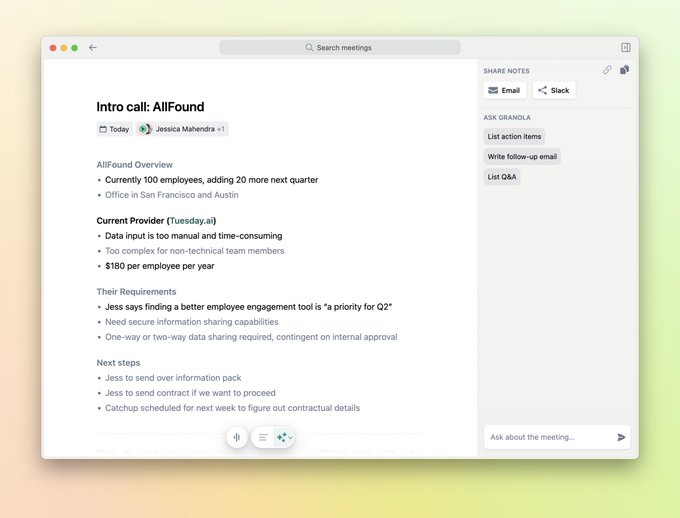
Granola is an AI note taker that works more like an intelligent notepad than a classic meeting bot. You can type your own rough notes during the call, and Granola uses the transcript to turn them into a cleaner summary afterward.
Granola features
Granola’s main difference is that it does not join your meeting as a visible bot.
Instead, it runs from your device, captures your microphone and system audio, and transcribes the meeting locally before creating enhanced notes.
Its main features include:
- Bot-free meeting capture: Granola does not join your call as a participant.
- Manual meeting start: It does not auto-join or auto-record. You have to start the note yourself.
- AI-enhanced notes: You can write your own notes, then Granola improves them with context from the transcript.
- Meeting transcription: Granola transcribes meetings from your device audio and microphone.
- Custom note templates: You can format notes for customer discovery, user interviews, pitches, 1:1s, standups, and other recurring meetings.
- AI chat: You can ask questions across your notes and transcripts.
- Action-item support: Granola can help list next steps, objections, budgets, follow-up points, and decisions.
- Sharing: You can share notes by public link, email, CRM, project updates, ATS notes, or internal folders.
- Desktop and mobile apps: Granola works on macOS, Windows, and iPhone.
- Phone call notes: On iPhone, Granola can capture outbound phone calls and generate AI-powered summaries.
This makes Granola a good fit if you like writing notes yourself, but want AI to fill in what you missed.
Quality of transcript & notes
Granola’s note quality is its biggest strength.
You can use Granola to create:
- Customer discovery notes
- User interview summaries
- Sales call recaps
- 1:1 notes
- Standup notes
- Candidate notes
- Project updates
- Follow-up emails
- Action item lists
- Meeting takeaways
Granola also supports multi-language transcription on desktop when the multi-language setting is enabled.
On iOS, Granola analyzes the transcript and chooses one transcription language, so it is better to keep the meeting in one language. This matters if your team switches between languages during calls.
User reviews
Users often praise Granola for its simplicity and note quality.
On G2, common positive themes include ease of use, daily use, intuitive design, easy setup, and flexible note-taking. Users also like that Granola helps them stay focused during meetings instead of writing everything manually.
Common positive points include:
- Clean interface
- Easy setup
- Strong meeting summaries
- Helpful action items
- No visible meeting bot
- Good for daily meeting workflows
- Useful for founders, managers, recruiters, and product teams
- Better focus during live conversations
There are also some limits.
Some users mention missing integrations, limited language support, limited features, or occasional AI inaccuracies. Others may miss a full web version for capturing meetings, since transcription requires the desktop or iPhone app.
Security
Its security page says Granola is SOC 2 Type 2 certified and committed to GDPR compliance. It also says Granola does not add a bot to your call, does not auto-record meetings, and requires you to manually start notes.
Important security points include:
- SOC 2 Type 2 certification
- GDPR commitment
- No meeting bot
- Manual recording start
- No stored meeting audio on desktop
- Google Workspace and Microsoft login
- Calendar integration
- Enterprise admin controls
- SSO on Enterprise
- Org-wide auto-deletion periods on Enterprise
- Org-wide model-training opt-out on Enterprise
There is one important caution.
Recent reporting noted that Granola notes shared by link may be viewable by anyone with that link, depending on your settings. It also reported that non-enterprise users may need to opt out manually if they do not want anonymized data used to improve Granola’s own models.
Integrations
Granola is lighter on integrations than some larger meeting intelligence platforms, but it covers important workflows.
Its Business plan includes advanced integrations with:
- Attio
- Notion
- Slack
- HubSpot
- Affinity
- Zapier
Granola also supports MCP integration, API access, shared folders, and calendar-based meeting workflows.
Pricing
Granola has three main plans:
- Basic: $0 per user/month, with AI meeting notes, limited meeting history, AI chat, shared folders, custom note templates, multi-language support, and the option to opt out of model training.
- Business: $14 per user/month, with unlimited meeting notes and history, advanced AI models, integrations, centralized billing, user management, MCP integration, and API access.
- Enterprise: $35 per user/month, with enterprise security, admin controls, SSO, priority support, usage analytics, org-wide auto-deletion, admin controls for sharing and API access, and org-wide model-training opt-out.
8. Jamie
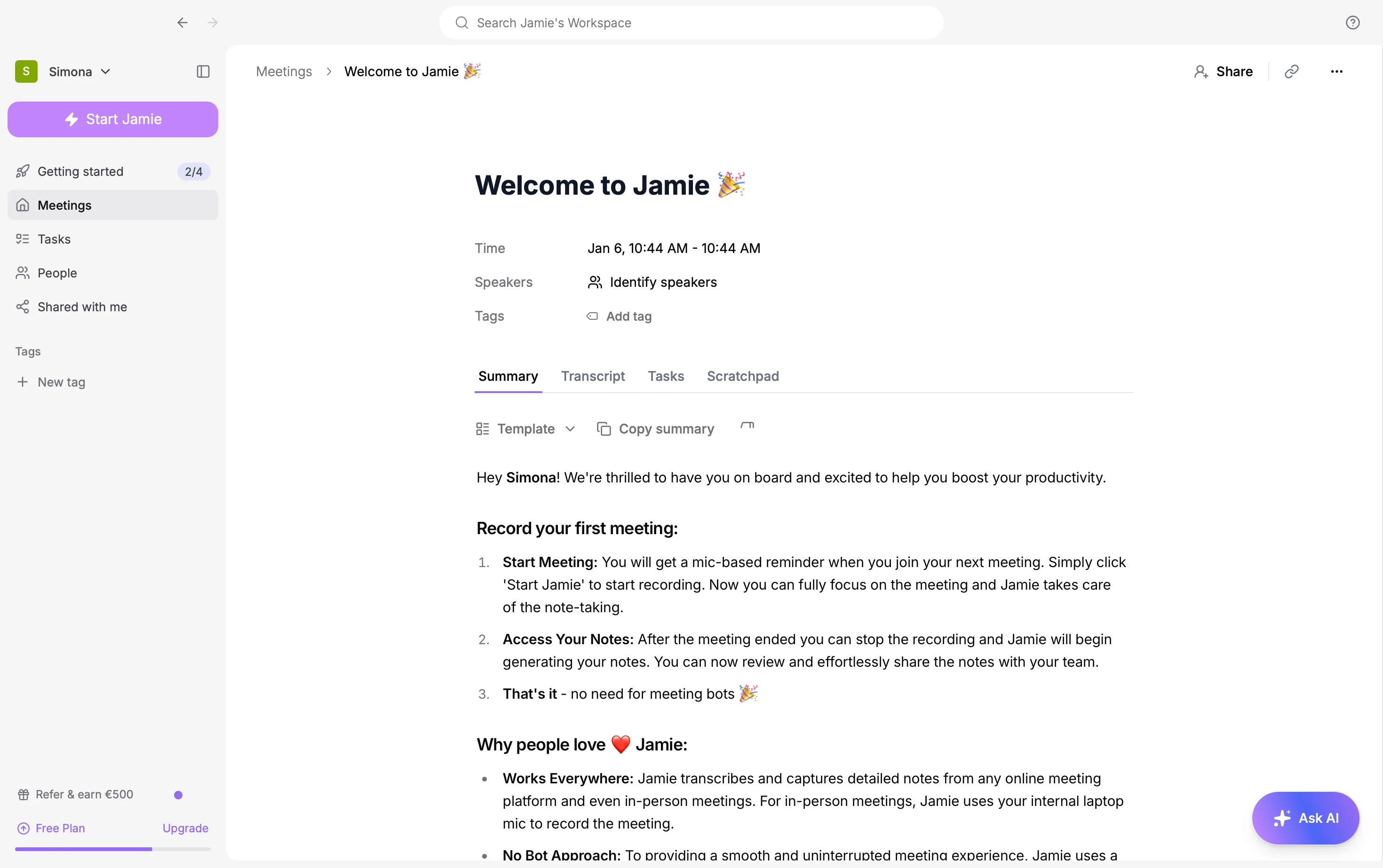
Jamie is a new emerging AI note taker focusing on privacy features.
Jamie features
Jamie’s main advantage is its bot-free setup.
Its main features include:
- Bot-free meeting notes: Jamie does not join your call as a visible participant.
- Online and offline capture: You can use it for online meetings, hybrid meetings, and in-person conversations.
- Structured meeting notes: Jamie turns conversations into organized notes, not just raw transcripts.
- Transcripts: You get a written record of the meeting after processing.
- Action items: Jamie detects tasks and next steps from the conversation.
- Speaker recognition: It can label speakers and remember them across meetings.
- Ask AI: You can ask questions about your meetings and retrieve details from previous conversations.
- Custom templates: You can format notes based on your recurring meeting types.
- Tags and workspace organization: Team plans include shared workspaces and tags.
- Mobile app: On iPhone, you can record in-person meetings, pause and continue during the conversation, create voice memos, and sync notes with desktop.
Quality of transcript & notes
Jamie focuses on human-like meeting summaries.
Its official homepage says it supports summaries in 99+ languages, while other product materials position Jamie around 100+ languages. G2 lists broad language support and describes Jamie as working across all video platforms and offline.
You can use Jamie to create:
- Meeting summaries
- Full transcripts
- Action items
- Speaker-labeled notes
- Highlights
- Follow-up points
- Topic-based notes
- Searchable meeting records
- Notes from online meetings
- Notes from in-person conversations
User reviews
Jamie’s G2 profile is positive, but the review volume is still small.
At the time of research, G2 shows 22 reviews and a 4.8 out of 5 rating. Review summaries highlight ease of use, accurate meeting notes, note management, transcription, and the fact that Jamie works without a bot.
Common positive points include:
- Easy to use
- No visible meeting bot
- Good meeting summaries
- Helpful action items
- Strong note organization
- Useful for confidential meetings
- Works across platforms
- Lets you stay focused during the conversation
There are also some limitations to mention.
G2 review themes include AI inaccuracy, recording issues, poor audio quality, and occasional inaccurate transcription. Trustpilot has only 4 reviews, with a 3.1 score and complaints about missed or lost meetings.
Security
Security is one of Jamie’s strongest selling points.
Its security page says Jamie is GDPR compliant, hosted in the EU, and ISO 27001 certified. It also says meeting audio is deleted after transcription and that customer data is never used to train Jamie’s models or third-party model providers.
Important security points include:
- GDPR compliance
- EU hosting
- ISO 27001 certification
- No meeting bot
- No stored audio
- No model training on customer data
- HTTPS and TLS 1.2 for connections
- AES-256 encryption at rest
- Flexible data retention rules
- Admin controls
- SAML SSO on Enterprise
- Regular penetration testing
- DORA compliance positioning
Integrations
Jamie’s integrations are more focused than some larger meeting intelligence tools.
Its pricing page lists integrations with:
- Google Docs
- Notion
- OneNote
- Asana
- Salesforce
- HubSpot
- Attio
- API and webhooks
Pricing
Jamie offers five main plans:
- Free: €0/month, with 10 meetings per month, a 30-minute meeting duration limit, and integrations with Notion, Google Docs, and OneNote.
- Plus: €25/month monthly, or €21/month billed annually, with 20 meetings per month and a 2-hour meeting limit.
- Pro: €47/month monthly, or €39/month billed annually, with unlimited meetings, a 3-hour meeting duration limit, and integrations such as Salesforce, HubSpot, and Asana.
- Team: €39/month/user monthly, or €33/month/user billed annually, with unlimited meetings, centralized billing, advanced collaboration, and encryption at rest and in transit.
- Enterprise: Custom pricing, with volume discounts, SAML SSO, admin controls, EU data residency, DPAs, ISO 27001 support, and personalized onboarding.
Jamie is best for privacy-conscious professionals who want bot-free AI notes for online and in-person meetings.
9. Plaud
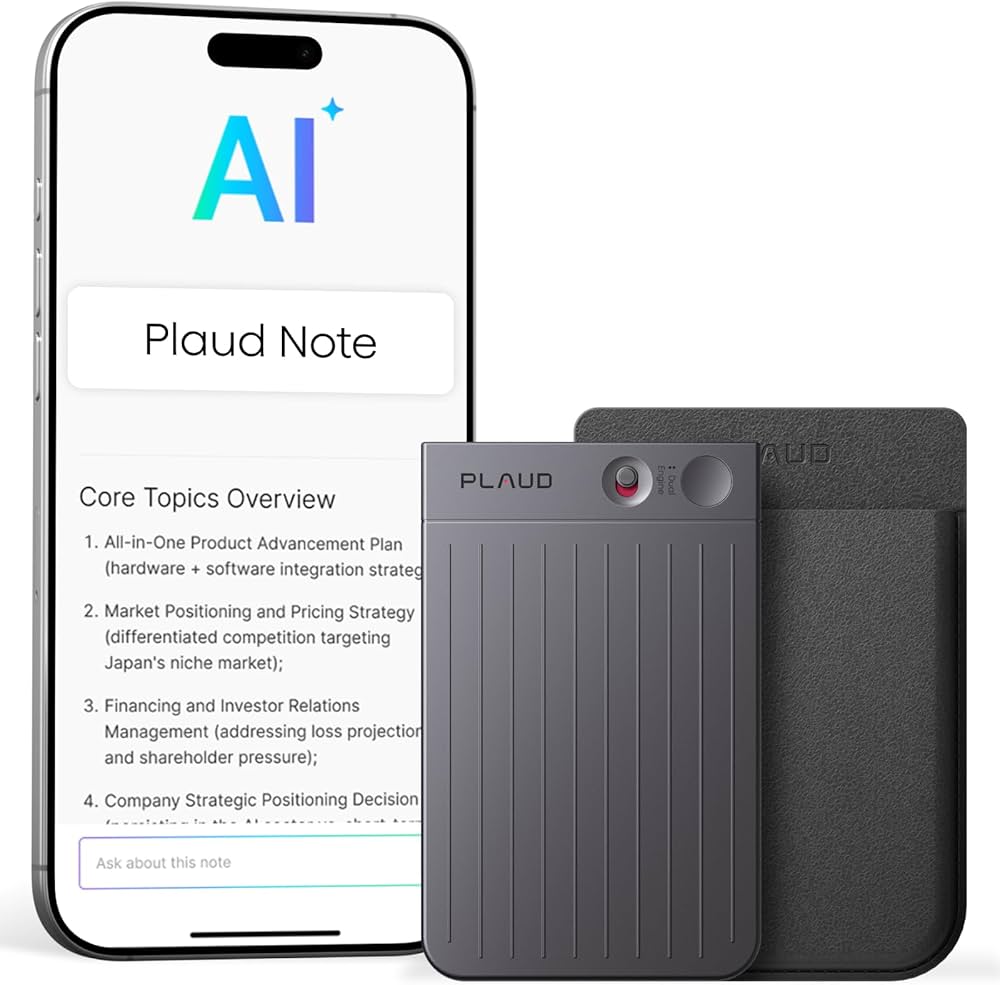
Instead of being only a software assistant, Plaud sells dedicated AI recording devices. You can use them to capture in-person meetings, phone calls, interviews, conferences, field work, and online conversations.
Plaud features
Plaud’s main value is hardware-based capture.
You do not need to rely only on your laptop microphone or meeting platform. You can use a small device to record conversations, then sync the audio to the Plaud app, Plaud Web, or Plaud Desktop.
Its main features include:
- Dedicated AI recorders: Plaud offers devices such as Plaud Note, Plaud NotePin S, and Plaud Note Pro.
- In-person recording: You can record live meetings, interviews, lectures, and client conversations.
- Phone call recording: Plaud Note is designed to capture phone calls as well as in-person conversations.
- Online meeting recording: Plaud Desktop can capture online meetings from your computer.
- AI transcription: Plaud Intelligence turns recordings into transcripts.
- AI summaries: You can generate structured summaries, meeting notes, action items, and insights.
- Templates: Plaud promotes 10,000+ professional templates for meetings, interviews, calls, and other use cases.
- Ask Plaud: You can ask questions about your recordings and retrieve information from past conversations.
- Speaker labels: Plaud can identify different speakers inside the transcript.
- Custom vocabulary: You can improve recognition for names, industry terms, and recurring words.
This makes Plaud useful if your work happens outside classic video meetings.
Quality of transcript & notes
Plaud supports transcription in 112 languages.
One important detail: Plaud’s support page says mixed-language transcription in the same recording is not currently supported. You should choose the main spoken language for best results.
You can use Plaud to create:
- Full transcripts
- Speaker-labeled notes
- Meeting summaries
- Mind maps
- Action items
- Interview notes
- Call summaries
- Client consultation records
- Searchable meeting history
- AI answers from recorded content
The hardware also matters.
Plaud Note has 64GB of storage, a 400mAh battery, and up to 30 hours of continuous recording. Plaud NotePin S has 64GB of storage, up to 20 hours of continuous recording, and can be worn as a necklace, wristband, clip, or magnetic pin.
Plaud Note Pro is the more advanced model. It adds a display, smart dual-mode recording, 64GB storage, a longer pickup range, and up to 50 hours of recording in endurance mode.
User reviews
Plaud receives strong feedback from users who need a dedicated recorder.
People often like the portability, battery life, recording quality, summaries, and convenience. It is especially useful for professionals who attend many in-person conversations and do not want to rely on a phone app.
Common positive points include:
- Easy physical recording
- Strong for meetings and interviews
- Useful AI summaries
- Good portability
- Long battery life
- Helpful speaker labels
- Works outside Zoom, Meet, or Teams
- Good fit for consultants, doctors, journalists, students, and salespeople
There are also clear limitations.
Some reviewers question whether a separate device is necessary when phones already offer voice recording. Others mention subscription cost, transcription delays, and app friction.
So, Plaud is strongest when you truly need dedicated hardware. If all your meetings happen online, a software-first AI note taker may be simpler.
Security
Plaud has a strong compliance position for a hardware AI note-taking brand.
Its support pages say Plaud is compliant with or certified under several major standards, including:
- SOC 2 Type II
- HIPAA
- GDPR
- ISO 27001
- ISO 27701
- EN 18031
Integrations
Plaud is not as integration-heavy as some software AI meeting assistants, but it does support workflow automation.
Its main integration path is Zapier.
Through Zapier, you can send Plaud transcripts and summaries to apps such as:
- Google Docs
- Notion
- Gmail
- Slack
- Other Zapier-connected tools
Pricing
Plaud pricing has two parts: the device and the AI plan.
Key pricing points include:
- Plaud devices: Pricing depends on the model, such as Plaud Note, NotePin S, or Note Pro.
- Starter plan: Every Plaud device includes 300 transcription minutes per month at no extra cost.
- Pro plan: Plaud’s Annual Pro Plan includes 1,200 AI transcription minutes per month.
- Unlimited plan: Plaud also offers an unlimited AI plan for heavier users.
- Add-on minutes: You can buy extra transcription packs, such as 600, 3,000, or 6,000 minutes.
10. Read AI

Read AI is another AI Note taker that does the job.
Read AI features
Its main features include:
- AI meeting assistant: Read AI can join Zoom, Microsoft Teams, and Google Meet meetings to take notes automatically.
- Live notes and metrics: It provides real-time transcription, summaries, and meeting metrics during the conversation.
- Meeting reports: After each meeting, Read AI generates a report with summary, topics, action items, and key questions.
- Full transcription: It creates speaker-based transcripts, with listener sentiment and engagement signals.
- Audio and video playback: On higher plans, you can replay meeting recordings.
- Video highlights: Enterprise users can access highlights from recorded meetings.
- Meeting coach: Read AI gives personal coaching metrics such as talking speed, filler words, bias, and charisma.
- Topic readouts: You can track recurring themes across meetings, emails, and messages.
- Ask Read: You can search across meetings, emails, chats, and connected apps.
- Desktop and mobile apps: Read AI has Windows, macOS, Android, and iOS apps.
- File uploads: Paid plans include monthly file upload credits.
Quality of transcript & notes
Read AI gives you structured meeting outputs after each call.
You can use it to create:
- Meeting summaries
- Full transcripts
- Action items
- Key questions
- Topic sections
- Engagement insights
- Sentiment signals
- Coaching reports
- Video highlights
- Searchable meeting history
User reviews
User feedback on Read AI is very mixed.
On G2, users often praise the tool for clear summaries, automatic transcription, meeting productivity, and the ability to stay focused during calls. Many users like the meeting reports because they make follow-up easier.
Common positive points include:
- Clear AI summaries
- Automatic transcription
- Useful meeting reports
- Good productivity gains
- Helpful action items
- Strong analytics
- Useful coaching insights
- Search across conversations
However, Read AI also receives strong criticism on Trustpilot.
Many complaints focus on privacy perception, the assistant joining meetings unexpectedly, difficulty removing it, unwanted emails, or discomfort with sensitive meetings being summarized.
This is important. Read AI can be powerful, but your team should configure it carefully before using it across client, legal, financial, HR, or executive meetings.
Security
Read AI publishes a security and privacy overview.
It says meeting data is encrypted during transmission and storage. It also says data captured during video conference calls is stored encrypted at rest within AWS us-east-1 in Northern Virginia, USA.
Important security points include:
- Regular SOC 2 audits
- Regular penetration tests
- Encryption in transit
- Encryption at rest
- AWS us-east-1 data storage by default
- Custom storage-location options for large group purchases
- HIPAA compliance on Enterprise+
- SSO and SAML on Enterprise+
- Domain capture on Enterprise+
- Custom data retention policy on Enterprise+
- Account and privacy center for data requests and account deletion
Integrations
Read AI has a broad integration library.
Important integrations include:
- Video tools: Zoom, Google Meet, Microsoft Teams
- Messaging: Slack, Microsoft Teams
- Notes: Google Docs, Microsoft OneNote, Notion
- Email and productivity: Gmail, Outlook
- CRM: Salesforce, HubSpot
- Project and knowledge tools: Jira, Confluence
- Automation: Zapier, webhooks, API
- AI workflows: OpenAI ChatGPT, Anthropic Claude, MCP
Pricing
Read AI offers four main plans:
- Free: $0, with 5 meeting transcripts per month, unlimited enterprise search, summaries for meetings, email, and messaging, personalized meeting coach, topic readouts, basic integrations, 20+ supported languages, and apps for Windows, macOS, Android, and iOS.
- Pro: listed from $15 per user/month billed annually, with unlimited meeting transcripts, 100 file upload credits per month, priority report processing, and premium integrations such as Notion, Salesforce, HubSpot, Jira, Confluence, Zapier, and webhooks.
- Enterprise: listed from $22.50 per user/month billed annually, with audio and video playback, video highlights, 200 file upload credits per month, and premium support.
- Enterprise+: listed from $29.75 per user/month billed annually, with a 5-license minimum, HIPAA compliance, SSO and SAML, domain capture, custom data retention, 300 file upload credits per month, and workspace onboarding.
FAQ
1. Are AI-based note-taking tools secure?
Yes, most AI-based note-taking tools prioritize the security and confidentiality of user data. They use double encryption, secure connections and data protection measures to ensure the safety of your notes and information.
2. Can AI note-taking tools be used offline?
Some AI note-taking tools offer offline recorders, enabling users to access and create notes without an Internet connection. However, some features may require an Internet connection to function fully.
3. Can I export my notes from IA note-taking tools?
Yes, most AI note-taking tools offer options for exporting your notes in different formats, such as PDF, Word or HTML. This allows you to share or archive your notes outside the tool.
4. Can AI note-taking tools recognize handwriting?
Yes, some AI-based note-taking tools are equipped with handwriting recognition features. They can convert handwritten notes into digital text, making them searchable and editable.
5. Are AI note-taking tools compatible with mobile devices?
Yes, AI note-taking tools generally have mobile apps compatible with iOS and Android devices. This allows you to access and update your notes wherever you are, using your smartphone or tablet.
Meet the Writer
.avif)
Adesh Sonawane explores how teams can better capture knowledge and collaborate more effectively with AI
FAQ
Does Noota work without a visible meeting bot?
Yes, Noota offers bot-free recording via Chrome extension for discreet capture.
- No visible bot joins Google Meet or Zoom
- Also supports traditional bot recording when needed
- Works for in-person meetings via mobile app
What languages does Noota support for transcription and translation?
Noota transcribes in 80+ languages and translates into 30+ languages for global teams.
- High-accuracy transcription for multilingual meetings
- Automatic language detection during live calls
- Translation available across all meeting formats
How does Noota compare to other AI meeting assistants?
Noota combines features competitors split across multiple tools — meetings, calls, and email in one platform.
- Business telephony with call recording built-in
- AI email automation drafts follow-ups from meeting content
- Saves 6.4 hours per week per team member
Can Noota create custom meeting templates for different use cases?
Yes, Noota lets you build custom templates to format notes for sales, interviews, or workshops.
- Structured reports match your workflow needs
- Auto-extracts action items and key decisions
- Templates work across meetings, calls, and uploads
Which AI note taker is best for teams needing CRM integration and compliance?
Noota is built for regulated industries with GDPR and SOC 2 compliance, plus native CRM sync.
- Auto-syncs meeting data to Salesforce and HubSpot
- Reduces administrative work by 80% with automated reports
- European-based with enterprise-grade security features
Try Noota free — no credit card needed.