Meeting Recording & Transcription
8 min reading
Updated on:
Oct 20, 2026
How to Get Real Time Meeting Transcription Anywhere
Turn on real-time meeting transcription in Teams, Zoom and Google Meet, or record without a bot joining the call. Step-by-step setup guide.
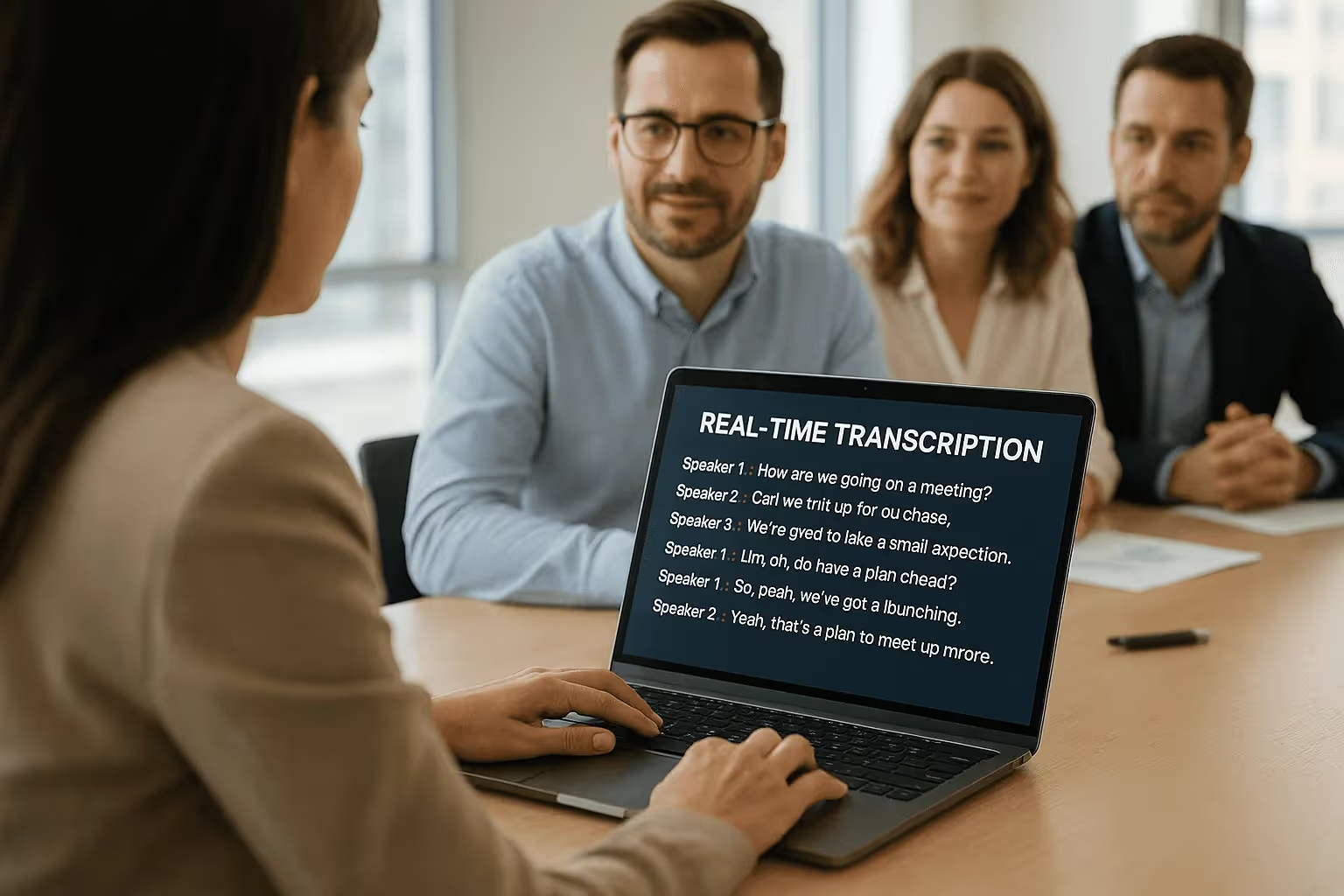
Real-time meeting transcription converts spoken conversation into accurate, searchable text while your meeting is happening. You can turn it on through your video platform's built-in captioning, route audio through a dedicated desktop assistant, or capture in-person conversations on your phone.
This guide walks through the exact setup steps for Microsoft Teams, Zoom, and Google Meet, breaks down why native captions fail business workflows, and shows you how to capture clean transcripts without sending an unwanted bot into the room.
Which Setup Fits Your Meeting?
1. How to Enable Built-in Live Transcription by Platform
If you only need live text on your screen to follow along during a conversation, here is how to turn on native captions:
Microsoft Teams
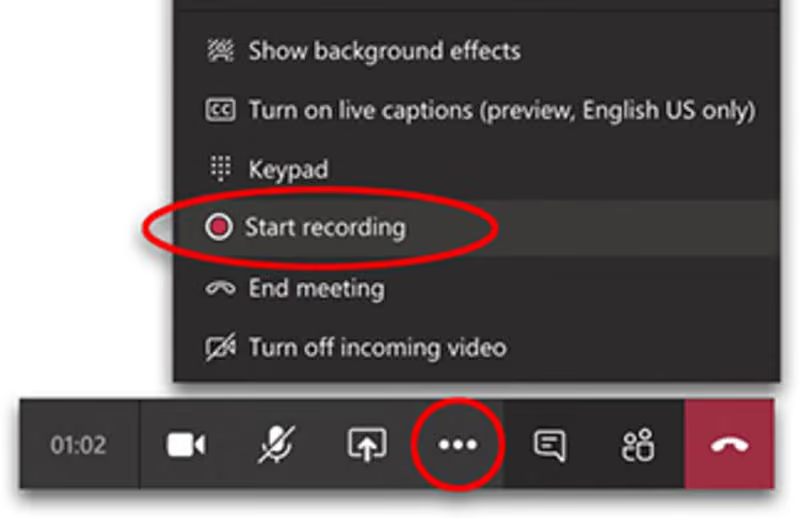
- Join your meeting and click More actions (...) in the top menu bar.
- Select Record and transcribe > Start transcription.
- Live captions with speaker names and timestamps appear in the right-hand panel.
- When the meeting ends, the transcript is saved in the meeting chat.
Admin Note: If this option is greyed out, your IT administrator has locked it. It must be enabled under Teams Admin Center > Meetings > Meeting policies > Recording & transcription.
Zoom
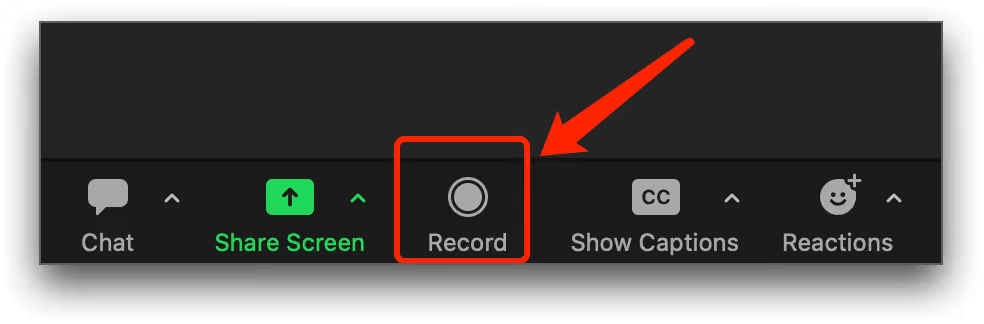
- In your meeting controls, click Show Captions (or More > Captions).
- Choose your speaking language.
- Click View Full Transcript to open the running dialogue in the side panel.
- If you want participants to save the transcript, the host must enable Save Captions in their Zoom Web Portal settings.
Google Meet
- Click the Turn on captions button (cc) at the bottom of your screen.
- Google Meet displays real-time subtitles across the lower third of the video.
The Trap: Google Meet native captions are ephemeral. They are visible only to the person who turns them on and vanish permanently the moment the call ends. Google Meet does not save, export, or summarize your conversation unless you use a dedicated meeting assistant.
2. Why Built-in Captions Fail Business Teams
For personal accessibility, native captions work well. But if you run client discovery calls, agency syncs, or project workshops, relying on free captions creates four critical bottlenecks:
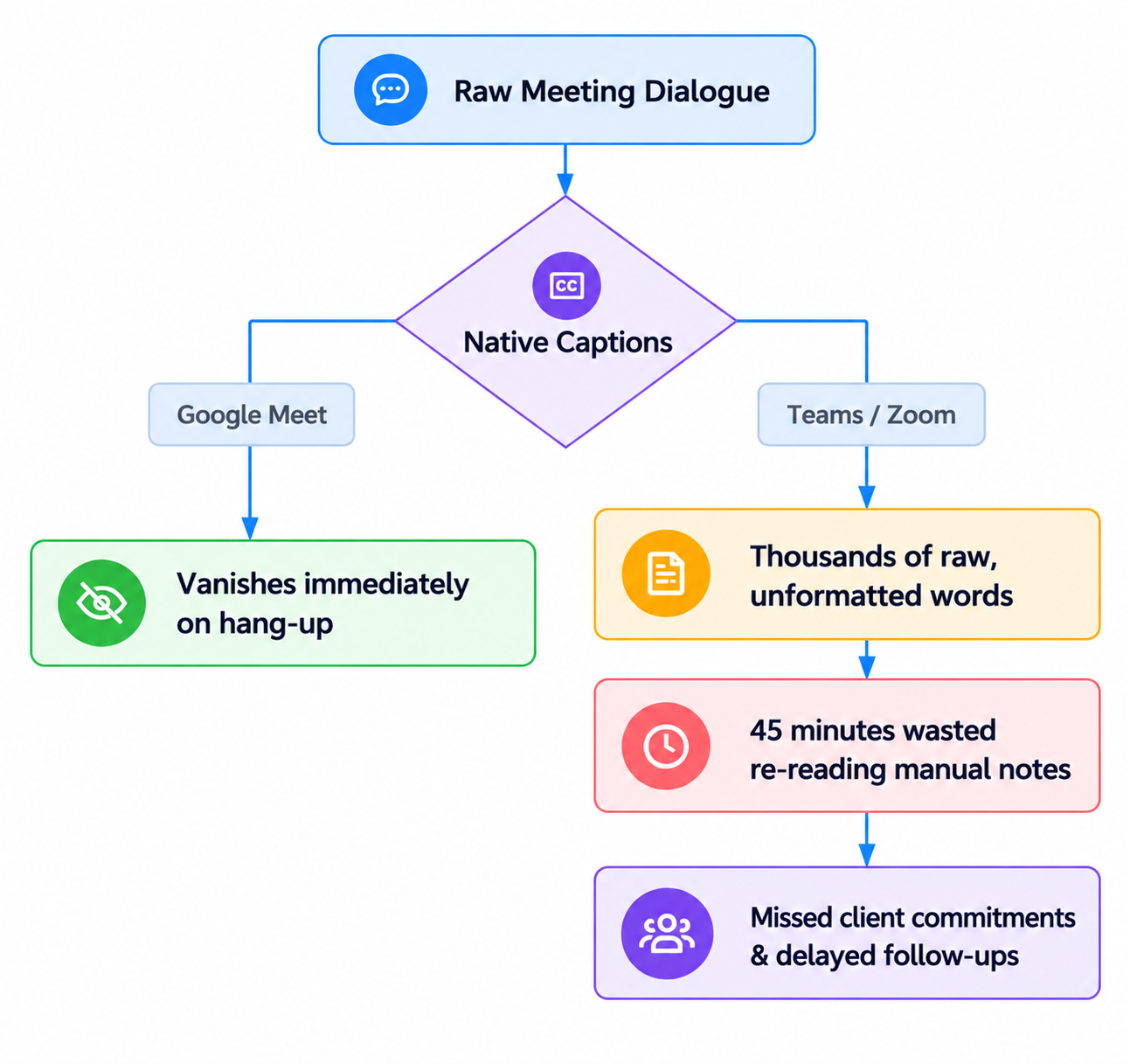
- They vanish or create manual homework: Reading a raw 5,000-word transcript takes almost as long as the meeting itself. Nobody has time to sift through small talk to find deliverables.
- They do not capture phone calls or in-person syncs: Native captions only exist inside that specific video tab. If you take a client call on your phone or meet over coffee, you are back to pen and paper.
- Bots get blocked by corporate IT policies: Most third-party transcription tools send an external bot ("Assistant Bot") into your video room. On enterprise calls, IT security firewalls and lobby admins regularly reject external bots at the door.
- Intrusive bots damage client rapport: In client negotiations, candidate interviews, or agency strategy sessions, an uninvited recording bot creates instant hesitation.
3. The Professional Alternative: Invisible Real-Time Transcription
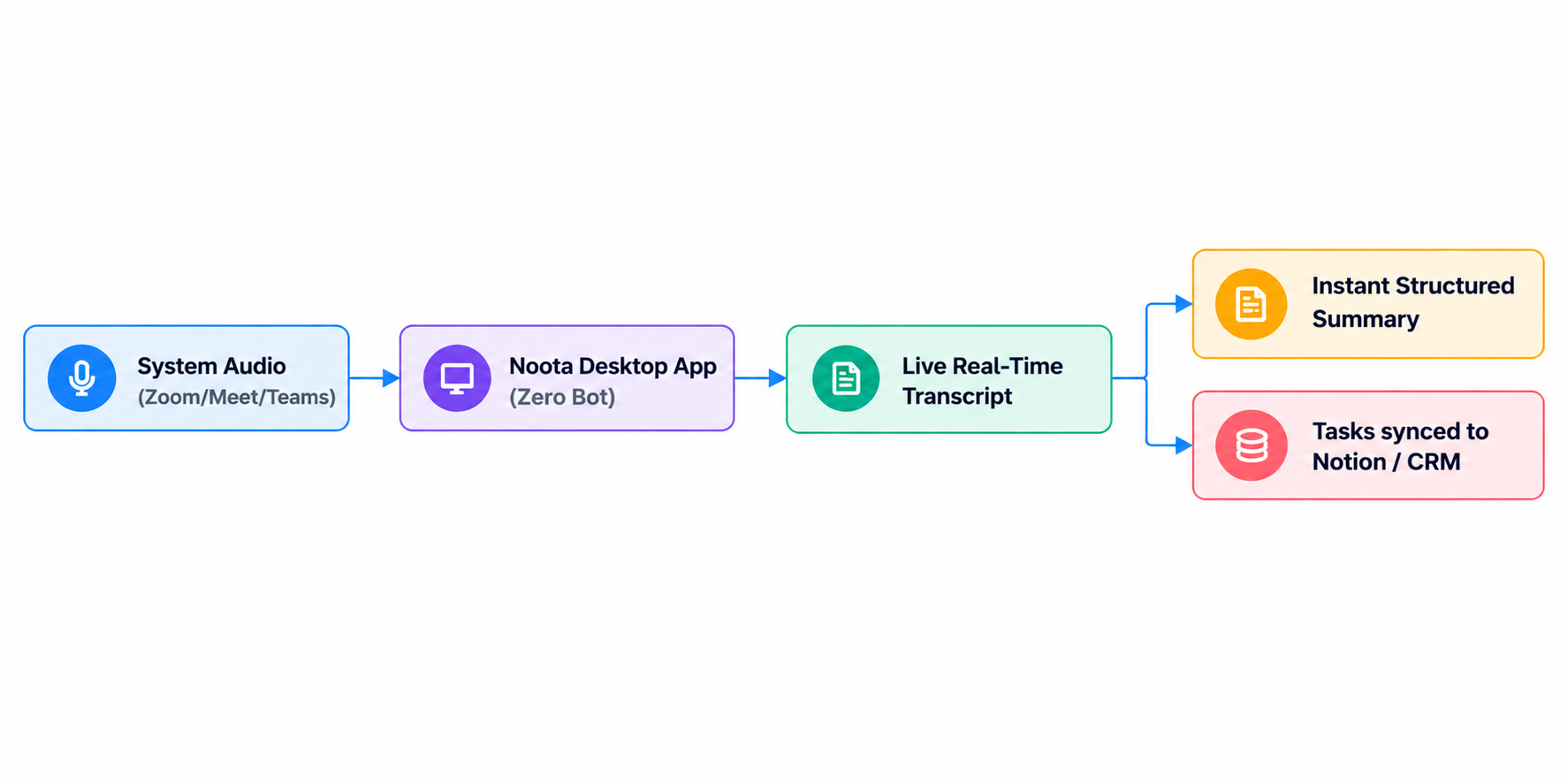
To capture every conversation without cluttering your meeting with bots, you need a workflow that captures audio at the system level.
This is why knowledge teams use Noota:
Step 1: Record Without an Intrusive Bot
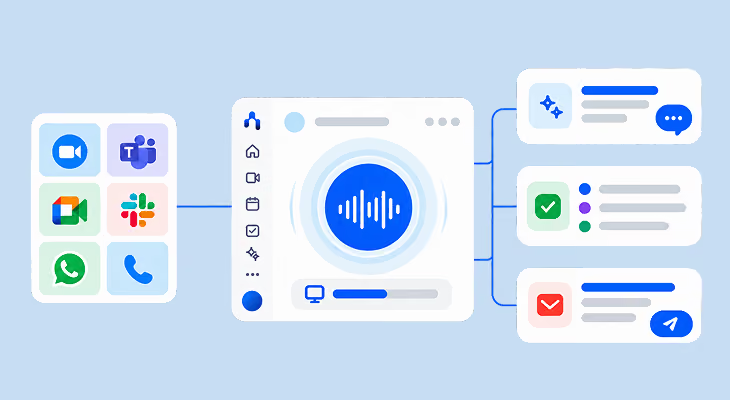
Download the Noota Desktop app (Mac & Windows). Instead of sending a bot to your meeting link, Noota captures audio directly from your computer's virtual output and microphone.
- Works across Zoom, Microsoft Teams, Google Meet, and Webex.
- No bot appears in your meeting grid.
- It completely bypasses corporate IT bot blocklists.
- For phone calls and on-the-go meetings, use the Call Recorder or mobile app.
Step 2: Live Transcription with Speaker Attribution
As participants speak, the transcript populates in real time with distinct speaker tags and timestamps across 50+ languages. You can drop inline bookmarks or highlight key moments live with one click.
Step 3: Turn Conversations into Instant Deliverables
The moment the call ends, Noota converts the raw transcript into your chosen business deliverable:
- Marketing & Growth Agencies: Turns messy client calls into formatted status reports, brief-to-deliverable roadmaps, and instant recap emails.
- AI & Product Teams: Captures qualitative user discovery interviews, tagging pain points and feature requests.
- Consultancies & ESNs: Formats scoping workshops into technical specifications and governance documentation.
- RevOps & Sales Teams: Automatically pulls action items via the Task System and syncs contact notes directly to your CRM or Notion workspace through native automations.
4. Under the Hood: Accuracy, Infrastructure & European Data Sovereignty
Real-time meeting transcription demands two technical guarantees: sub-second streaming latency and strict data sovereignty.
Multi-Speaker Accuracy
To deliver streaming transcription across 50+ languages without audio lag, Noota partners with Gladia, an enterprise-grade European speech-to-text infrastructure engine optimized for real-time accents and audio clarity. (Disclosure: Gladia is Noota's speech-to-text provider.)
Immediately after the meeting ends, Noota runs a secondary language model pass that cleans up cross-talk, verifies technical jargon, and formats your custom template.
Where Does Your Voice Data Go?
Most US-hosted transcription tools route your meeting audio through foreign servers governed by the US CLOUD Act, creating severe compliance risks for European mid-caps and regulated industries.
Noota is built on strict data sovereignty:
- 100% European Infrastructure: All audio processing and data storage remain in Paris on Scaleway and Bleu sovereign infrastructure.
- Zero Model Training: Your voice recordings, meeting summaries, and customer data are never used to train public AI models.
- Enterprise Governance: Protected by workspace-level permissions, SSO (SAML), and ISO 27001 certification. Review our full architecture on the Security page.
5. Summary: Choosing the Right Tool for Your Team
- Use built-in captions if you only need live visual assistance on your own screen during a call and do not need to save the notes.
- Use Noota Desktop if you want automated meeting summaries, tasks synced to Notion and your CRM, bot-free recording that bypasses IT firewalls, and guaranteed European data sovereignty.
Try Noota for free or book a 30-minute workflow demo to see how it captures your team's meetings.
Meet the Writer

Adesh writes on AI note takers, meeting recording, structured interviewing and hiring, from his work in AI-driven growth and hiring operations.
FAQ
Many corporate IT administrators block external meeting bots because they cannot verify where the bot's cloud server stores the audio stream. Noota Desktop bypasses this restriction entirely by capturing system audio directly on your local computer, functioning like a local microphone rather than an unauthorized meeting attendee.
Streaming engines transcribe speech with low latency, but heavy cross-talk or niche technical terminology can cause temporary transcription errors. Noota solves this by running an immediate post-call language model pass that resolves overlapping dialogue, verifies context, and applies custom vocabulary dictionaries to ensure accurate final deliverables.
Noota includes a native MCP Server (Model Context Protocol). This connects your meeting workspace directly to Claude or ChatGPT, allowing you to draft proposals, review sprint deliverables, and analyze customer calls inside your favorite AI interface.
Noota is rated 4.9/5 on G2 (314+ reviews) and 4.9/5 on Trustpilot. Over 5,000 teams and 200,000 knowledge workers rely on Noota daily to capture customer discovery, client workshops, and sensitive business discussions.