


Hiring & Talent Acquisition
8 min reading
Updated on:
Feb 16, 2026
Job Scope
Noota turns meeting notes into clear job scopes in minutes. Define roles, reduce admin, align teams—no credit card needed.
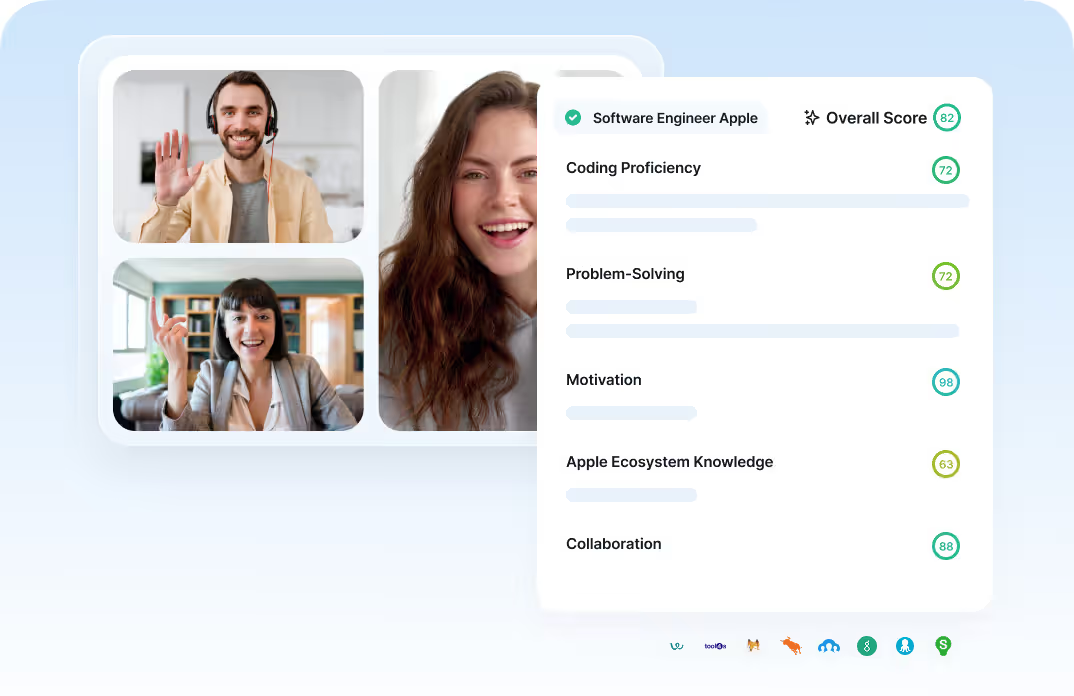
When your job scope is generated from real stakeholder conversations, it reflects reality. You also get a traceable source of truth, which makes it easier to resolve “who owns this?” moments without more meetings.
If you want, you can use Noota for the initial scoping meeting and every quarterly scope review. That way, your job scope stays current without becoming another admin project.Meetings are where roles get defined in real life. You agree on priorities, you assign ownership, and you align on what “good” looks like.
Then the meeting ends, and the clarity disappears into scattered notes. A week later, you’re back in another call debating the same responsibilities, the same handoffs, and the same “is this in scope?” questions.
A job scope document fixes that. It gives you a written perimeter for a role, so you can protect focus, speed up onboarding, and reduce role creep.
In this guide, you’ll learn what job scope really means, how to write one that’s actually usable, and a copy/paste template you can personalize in minutes. You’ll also see how you can generate a job scope faster using Noota, so your role-scoping meetings turn into a clean document instead of more admin work.
1. What is job scope?
Your job scope is the clear perimeter of a role. It explains what you’re responsible for, what you must deliver, and where your responsibilities stop. When it’s well written, you don’t have to guess what “doing a good job” looks like.
Think of it as a practical document you can use day to day. It helps you align expectations between you, your manager, HR, and the people you work with. It’s especially useful when a role is new, evolving, or shared across teams.
A job scope is not the same thing as a job description. Your job description is often built for hiring, so it usually includes company context, mission, required experience, and benefits. Your job scope is more operational, because it focuses on outcomes, responsibilities, and limits.
If you’re recruiting, you’ll still use a job description. But when you want role clarity, faster onboarding, and fewer misunderstandings, you’ll rely on a job scope document. It’s also a strong base for performance reviews, because it ties your work to measurable results.
A solid job scope typically includes a few core elements.
First, it states the purpose of the role in plain language. This is the “why” behind the job, in two or three lines. If you can’t explain why the role exists, it will be hard to prioritize later.
Then, it lists key responsibilities. These are the areas you own, written with action verbs and concrete wording. The goal is to make responsibilities hard to misinterpret.
Next come deliverables and outcomes. Deliverables are what you produce (reports, releases, handoffs, campaigns), while outcomes are what changes because of your work (higher conversion, faster resolution time, better retention). You need both to avoid a role that is busy but not impactful.
A good job scope also clarifies decision rights and boundaries. You’ll want to know what you can decide alone, what needs approval, and what is explicitly out of scope. This is where you prevent duplicated work and political friction.
Finally, it should name your key stakeholders and success metrics. Stakeholders tell you who you need to collaborate with, and metrics tell you how success is measured. With that, your role becomes clearer, your priorities become easier, and your meetings become shorter.
2. Best practices to define and write a job scope document
A job scope document only works if people can use it. That means it must be specific, easy to scan, and aligned with how work really happens in your team.
Below are best practices you can follow to define the role, write it clearly, and keep it updated.
2.1 Start from outcomes, not tasks
If you begin with a list of tasks, your job scope will quickly turn into a messy to-do list. Tasks change all the time, especially when your team grows or tools evolve.
Start with outcomes instead. Ask yourself what must be true in 3 to 6 months because this role exists.
Use questions like:
- What business result should this role drive?
- What problem is this role accountable for solving?
- What does “success” look like in concrete terms?
Then, connect responsibilities to those outcomes. This helps you keep the scope stable, even when day-to-day tasks shift.
2.2 Use clear, concrete language (and action verbs)
Your job scope should reduce interpretation, not invite it. If you use vague words, you’ll get vague expectations.
Prefer action verbs such as:
- Own, deliver, manage, coordinate, analyze, improve, define, implement, report, maintain
Avoid lines like “support the team” or “help with projects” unless you specify what that means. If you must include them, add the “how” and the “when.”
For example:
- Vague: “Support the sales team.”
- Clear: “Provide weekly pipeline insights and recommend next actions based on CRM data.”
2.3 Separate responsibilities, deliverables, and KPIs
Many job scope documents fail because everything is mixed together. You end up with a list that is hard to measure and hard to manage.
Split the role into three categories:
- Responsibilities: what you own on an ongoing basis (your domains of ownership).
- Deliverables: what you produce (documents, dashboards, releases, handoffs).
- KPIs / success metrics: how your performance is measured (time, volume, quality, impact).
This separation protects you from “busy work.” It also makes performance conversations easier, because you can discuss outputs and outcomes with the same reference document.
2.4 Clarify boundaries and decision rights early
A role becomes stressful when you don’t know what you’re allowed to decide. It also becomes political when two people think they own the same thing.
In your job scope, be explicit about:
- What you can decide independently
- What requires approval (and from whom)
- Budget thresholds (if relevant)
- What is out of scope (work you do not own)
Add 3 to 6 “out of scope” bullets if the role overlaps with other teams. It may feel strict, but it prevents conflict later.
2.5 Define collaboration and interfaces (to prevent friction)
You don’t work alone, and your job scope should reflect that. If you skip collaboration rules, you create bottlenecks and surprises.
List the key stakeholders you’ll work with and what the interaction looks like. Keep it practical.
For example:
- “Works with Marketing to align campaign messaging with product positioning.”
- “Partners with Finance for quarterly forecasting and budget tracking.”
- “Coordinates with Support to identify recurring issues and prioritize fixes.”
If your organization likes structured ownership, you can add a light RACI-style line for key activities. You don’t need a complex table to be useful.
2.6 Write it for scanning (one page if possible)
Your job scope should be readable in two minutes. If it requires a long explanation, it won’t be used.
To keep it scannable:
- Use short sections and bullet points
- Put the most important items first
- Limit responsibilities to the essential (often 6 to 12 bullets)
- Keep paragraphs short, especially in internal documents
If you have extra detail (processes, tool instructions, examples), move it to an appendix or link to a separate doc. Your core scope should stay clean.
2.7 Validate with stakeholders, then version it
A job scope is not valid just because it’s written. It becomes useful when the right people agree on it.
Before you finalize, review it with:
- The manager who owns the role
- HR (if this impacts leveling, compensation, or hiring)
- The main cross-functional partners (the people most affected by the role)
Then add a simple versioning system:
- “Last updated” date
- Owner of the document
- Next review date (quarterly or twice a year works well)
This matters because roles evolve. If you don’t version your job scope, you’ll keep debating old expectations in meetings.
2.8 Pressure-test it with real scenarios
Before you publish the document, test it against reality. This is where you catch missing responsibilities, unclear boundaries, and unrealistic metrics.
Ask:
- If a stakeholder requests X, is it in scope or out of scope?
- If priorities conflict, what guides the decision?
- Could someone new in the role understand what to do in their first month?
- Are the KPIs measurable with the data you actually have?
If you can answer these questions confidently, your job scope is not just “well written.” It’s operational.
3. Job scope template (copy/paste)
You don’t need to start from scratch to write a job scope document. You can copy the template below, fill in the blanks, and adjust the sections to match your role and your company.
Keep it practical. If you can’t use a line to manage work, onboard someone, or evaluate performance, remove it.
3.1 Job scope document template (easy to personalize)
Document title: Job Scope — [Role Title]
Team / Department: [Team name]
Location / Work mode: [On-site / Hybrid / Remote]
Employment type: [Full-time / Part-time / Contractor]
Reports to: [Manager title]
Works closely with: [Teams / roles]
Version: [v1.0]
Last updated: [YYYY-MM-DD]
Next review date: [YYYY-MM-DD]
1) Role purpose (2–3 sentences)
Write why this role exists and what problem it solves.
Purpose:
- [Example: “Own the end-to-end customer onboarding process to reduce time-to-value and increase activation.”]
2) Key outcomes (3–7 bullets)
These are the results your role is accountable for.
Outcomes:
- [Outcome #1: e.g., “Reduce onboarding time from X to Y by [date].”]
- [Outcome #2: e.g., “Increase adoption of [feature/workflow] to X% within [segment].”]
- [Outcome #3: e.g., “Improve stakeholder satisfaction (CSAT/NPS) to X.”]
- [Outcome #4]
- [Outcome #5]
3) Core responsibilities (6–12 bullets)
Use action verbs and write what you own, not what you “help with.”
Responsibilities:
- Own [process/area] from [start] to [finish].
- Define and maintain [documentation/standards].
- Coordinate with [team] to [goal].
- Monitor [metric] and take corrective action when [condition].
- Build / deliver [asset] on a [weekly/monthly/quarterly] cadence.
- Identify and prioritize improvements based on [data/source].
- [Responsibility #7]
- [Responsibility #8]
4) Deliverables (what you produce)
List tangible outputs people can expect from you.
Deliverables:
- [Weekly/Monthly] [report/dashboard] shared with [audience].
- [Documentation] such as [SOPs, playbooks, requirements].
- [Project outputs] such as [launch plan, rollout checklist, release notes].
- [Meeting outputs] such as [decision logs, action plans, follow-ups].
- [Deliverable #5]
5) Success metrics / KPIs (how you’re evaluated)
Choose metrics you can actually track. Add targets when possible.
KPIs:
- Quality: [error rate, SLA compliance, audit score] → Target: [X]
- Speed: [cycle time, time-to-resolution, time-to-value] → Target: [X]
- Volume: [tickets handled, projects shipped, accounts onboarded] → Target: [X]
- Business impact: [revenue influenced, retention, conversion] → Target: [X]
- Stakeholder satisfaction: [CSAT/NPS/internal survey] → Target: [X]
6) Decision rights (what you can decide)
This is where you remove ambiguity.
You can decide independently:
- [Decision #1]
- [Decision #2]
Requires approval from [role/name]:
- [Decision #1]
- [Decision #2]
7) Key stakeholders & collaboration rules
Make collaboration predictable so you don’t waste time in meetings.
Stakeholders:
- [Team/role]: you work together to [goal], cadence: [weekly/monthly].
- [Team/role]: you hand off [deliverable] by [timing].
- [Team/role]: you consult them when [scenario].
8) Out of scope (explicit boundaries)
Write what you do not own to prevent role creep.
Out of scope:
- [Example: “Owning paid acquisition strategy and budget.”]
- [Example: “Providing 24/7 customer support coverage.”]
- [Out-of-scope #3]
- [Out-of-scope #4]
9) Tools & systems (optional)
Tools: [CRM], [Project management], [BI], [Support desk], [Docs], [Other]
10) Sign-off (optional but useful)
Prepared by: [Name]
Reviewed by: [Manager], [HR], [Key stakeholder]
Approved on: [YYYY-MM-DD]
If you tell me the role you’re scoping (title + team + goals), I can pre-fill this template with realistic outcomes, responsibilities, and KPIs you can edit.
4. Generate a job scope automatically: Noota
Most job scopes don’t fail because you don’t know what you want. They fail because the clarity lives inside meetings, not inside a document you can reuse.
You discuss ownership in a hiring sync, you refine it in onboarding, then you revisit it again when priorities shift. If your notes are incomplete or scattered, you end up rewriting the same thing and re-arguing the same decisions.
That’s where Noota fits naturally in your workflow. Since Noota is an AI meeting assistant, you can use it to capture your role-scoping conversations and turn them into structured content you can paste into your job scope template.
4.1 Turn role-scoping meetings into a job scope draft
Run one focused meeting with the right people. Typically, that’s you (or the hiring manager), the direct manager, and 1–3 key stakeholders from partner teams.
During the call, use Noota to record and transcribe the discussion, then generate clean meeting notes. Your goal is simple: convert what people say (“you’ll own X”) into what your document needs (outcomes, responsibilities, KPIs, boundaries).
4.2 A simple workflow you can copy
1) Schedule a “Job Scope Alignment” meeting (30–45 min).
Ask attendees to come prepared with expectations, pain points, and success criteria.
2) Capture the conversation with Noota.
Make sure decisions and ownership statements are explicitly said out loud.
3) Extract the job scope sections from the notes.
You’re looking for: outcomes, responsibilities, deliverables, stakeholders, decision rights, and out-of-scope items.
4) Paste into your template and share for review.
Send one doc, not five message threads, and ask for edits directly on the document.
5) Store the final version and update it as the role evolves.
When the scope changes, run a short update meeting and regenerate the modified sections.
4.3 Prompts that help you generate the right content
Use prompts like these on top of your meeting notes:
- “List the top 5 outcomes for this role, written as measurable results.”
- “Convert these notes into 8 responsibilities starting with action verbs.”
- “Identify decision rights: what can be decided independently vs needs approval.”
- “Extract all out-of-scope items mentioned or implied.”
- “Suggest KPIs that match the outcomes and can be tracked weekly or monthly.”
4.4 Why this saves you time (and avoids role creep)
Meet the Writer

FAQ
A job description is hiring-focused and includes company context, mission, and benefits. A job scope is operational—it defines responsibilities, deliverables, outcomes, and decision rights for day-to-day clarity.
- Job description: built for recruitment and external candidates
- Job scope: built for role clarity and performance alignment
- Job scope ties work to measurable results and reduces role creep
Job scope documents protect focus, speed up onboarding, and prevent recurring debates about ownership and responsibilities. They create a traceable source of truth from real stakeholder conversations.
- Stops 'who owns this?' meetings by clarifying decision rights
- Keeps roles current during quarterly reviews without extra admin
- Aligns expectations between managers, HR, and cross-functional teams
Manual templates require hours of writing and back-and-forth edits. Noota generates job scopes directly from meeting transcripts in minutes, saving 6.4 hours per week and reducing admin by 80%. Teams using Noota rate it 4.9/5 on G2.
- Noota extracts role clarity from real conversations automatically
- Manual templates create scattered notes that need constant updating
- Noota keeps job scopes current without becoming another admin project
Noota is purpose-built for turning meeting conversations into actionable documents like job scopes. It's trusted by 5000+ teams across 80+ languages and saves 6.4 hours weekly per team.
- Noota captures stakeholder input and generates drafts in minutes
- Creates a traceable source of truth from actual role-scoping conversations
- Supports quarterly reviews to keep job scopes current effortlessly