


Sales
8 min reading
Updated on:
Feb 14, 2023
Complex sales: method and techniques to close the deal.
Do you want to close deals with large accounts or complex companies? Here is a method to achieve it.
%20(1).webp)
Key accounts are a real opportunity for sales departments. They promise lucrative contracts and prestigious references.
But the challenge is as great as the expected gains! The constraints and specific challenges of large corporations can drag out your deals for months - what is called a complex sale.
This requires you to develop a personalized sales method to select, analyze, and approach your targets.
Here are some techniques to help you perfect the art of complex sales.
What qualifies a sale as complex?
As the name suggests, a complex sale is a commercial process that addresses a company with specific constraints and issues. It is often the case with larger companies that are more difficult to approach.
To be qualified as complex, a sale must admit one or more of these criteria:
- Long sales cycle: on average, a complex sale takes at least 6 months to reach a contract signature.
- Numerous stakeholders: as soon as several individuals are involved in the decision, roles are distributed and deliberations become more complicated.
- Tailor-made sale: the product or service is defined in collaboration with the buyer (consulting, services or software on demand).
- High perceived risk: key accounts are responsible for a larger number of operations and are therefore more averse to change.
- Technical issues: the product or solution sold involves technical issues that require the intervention of outside expertise.
Some examples of complex sales:
There are sectors where salespeople most often deal with complex sales (if you're in these sectors, you'll probably recognize yourself):
- Retail: numerous stakeholders between stores and brands.
- Construction: complexity and length of construction projects.
- Pharmaceuticals and healthcare: various regulatory issues.
- SaaS software industry: high competition and difficulty integrating into an existing stack.
- Etc...
The many benefits of complex sales:
Despite the difficulties of complex sales, the rewards can be great. You can expect:
- Deals with higher amounts.
- More opportunities for cross-selling and upselling.
- More prestigious references.
- Challenges and development of your salespeople's skills.
Do you want to try your luck and get into complex sales? Let's delve deeper into the subject.
What sales method to close complex sales?
Due to its scope, complex sales do not resemble a typical commercial process. It requires an approach method that can convince companies with specific structures and issues.
To achieve this, there is much to be gained from the current trend of account-based marketing (ABM). Instead of targeting a category of customers indiscriminately, ABM aims to adapt its prospecting and communication to specific targets.
This sales method focuses on a few key accounts, studies their peculiarities, nourishes them with dedicated marketing campaigns, and collaborates closely with them.
ABM is a very good response to complex sales. It allows you to focus your energy on a few well-chosen accounts and maximize your sales force.
Here's how you can apply it to your sales processes.
6 steps to track and close a complex sale:
Based on ABM, a successful method for approaching complex sales can be summed up in 3 Ps: personalized, impactful, personal.
Here are 6 steps to deploy it:
#1 Define your ICP precisely
If you are only targeting a few accounts, you might as well make sure they are the right ones.
This is the best way not to waste time on sales that, in addition to being complex, are not very profitable!
To make sure you're targeting the right accounts, you can define your ICP (Ideal Customer Profile), which is the typical profile of your ideal customer. You want to filter your prospecting to keep only companies that you know from experience will bring you the most revenue, loyalty, and new opportunities.
- Company size: How many employees do the most profitable companies have?
- Revenue: What is their turnover, budget, and average contract value (ACV)?
- Location: In which region are they located?
- Business issues: What are their typical needs and problems?
- Existing infrastructure: What tools, equipment, and systems are they already using?
When you apply these criteria in your search, you can reduce your account list to a few organizations that are truly compatible with your business.
#2 Map out your target organization
To maximize your sales efforts, you want to know your ICP's internal structure by heart. This involves studying and analyzing their organization chart, but also existing relationships around the final decision-maker:
You want to know who in your target organization represents:
- The decision-maker: the person who controls the budget and is responsible for the purchasing decision.
- The end user: the person who will directly benefit from your solution.
- The influencer: an external actor in the department who can have an influence on the project through their expertise or role.
- The executive office: who are the members of the executive committee and what are the latest themes driven by management?
Each of them can have a decisive contribution to the deliberations and can serve as a hook. That's why it's better to find out about them before you start soliciting them.
#3 Personalize your presentation and demo
A complex sale is complex for a reason: it is difficult to convince many actors of an unquestionable value proposition. You can take advantage of your first introduction calls to do in-depth research on your target and understand their crucial business issues.
For this, you can ask the following questions:
- What is the frustration you encounter in your existing work processes?
- How do you currently solve this problem manually?
- Do you have tools that currently allow you to remedy it?
- What are the limitations you have encountered with these existing or past tools?
With these elements in hand, you can then personalize your presentation slides and product demonstration. You want to highlight the features that are most in line with the issues mentioned by your client. This will make your sales approach even more impactful.
#4 Connect delivery team and client
A sale is even more complex when it involves actors from different departments and areas of expertise. And this is particularly the case when you sell solutions that require the intervention of internal technical or regulatory experts.
Your salespeople's word is no longer enough in these cases. You want to reassure your clients with specialists who know the nuances of the product or service inside and out.
To anticipate functional and technical constraints, you can plan ahead for a meeting between your teams and your clients. During this meeting, your experts can reassure them about legal risks, inform them about the installation process, demonstrate the product, or provide relevant studies.
#5 Nurturing with personalized sales content
In a complex sale, it is often difficult to stay in touch with potential opportunities. Send too many follow-ups and you risk alienating your prospect; leave the prospect alone and you risk losing a potential deal.
In these cases, lead nurturing becomes of paramount importance. You can regularly feed your prospects with relevant sales content and materials. This is a good way to stay in touch with your prospects while providing them with value.
- Educational articles and videos to evangelize the problem.
- Product presentations, technical documents to compare and inform.
- Commercial proposal with supporting pricing and relevant studies.
- Use case similar to your target company.
#6 Conduct individual and collective coaching sessions
As a sales manager, you have in your hands the sales strategy to conquer large companies. You can use regular individual and collective coaching sessions to improve the approach and prioritize actions:
- Monthly sales-marketing alignment point to discuss language elements and sales support.
- Weekly team meeting to discuss account allocation and hot topics raised by your target companies.
- Weekly individual meeting to analyze your salespeople's approaches and share best practices and language elements to prioritize.
Noota: Think of everything during your crucial meetings
Do you ever forget to ask a question or mention important information during your meetings? Noota is the meeting assistant you've always dreamed of.
With Noota, you can optimize your complex sales process by leveraging voice data. It allows you to:
- Define questions to ask and responses to give through a real-time assistant.
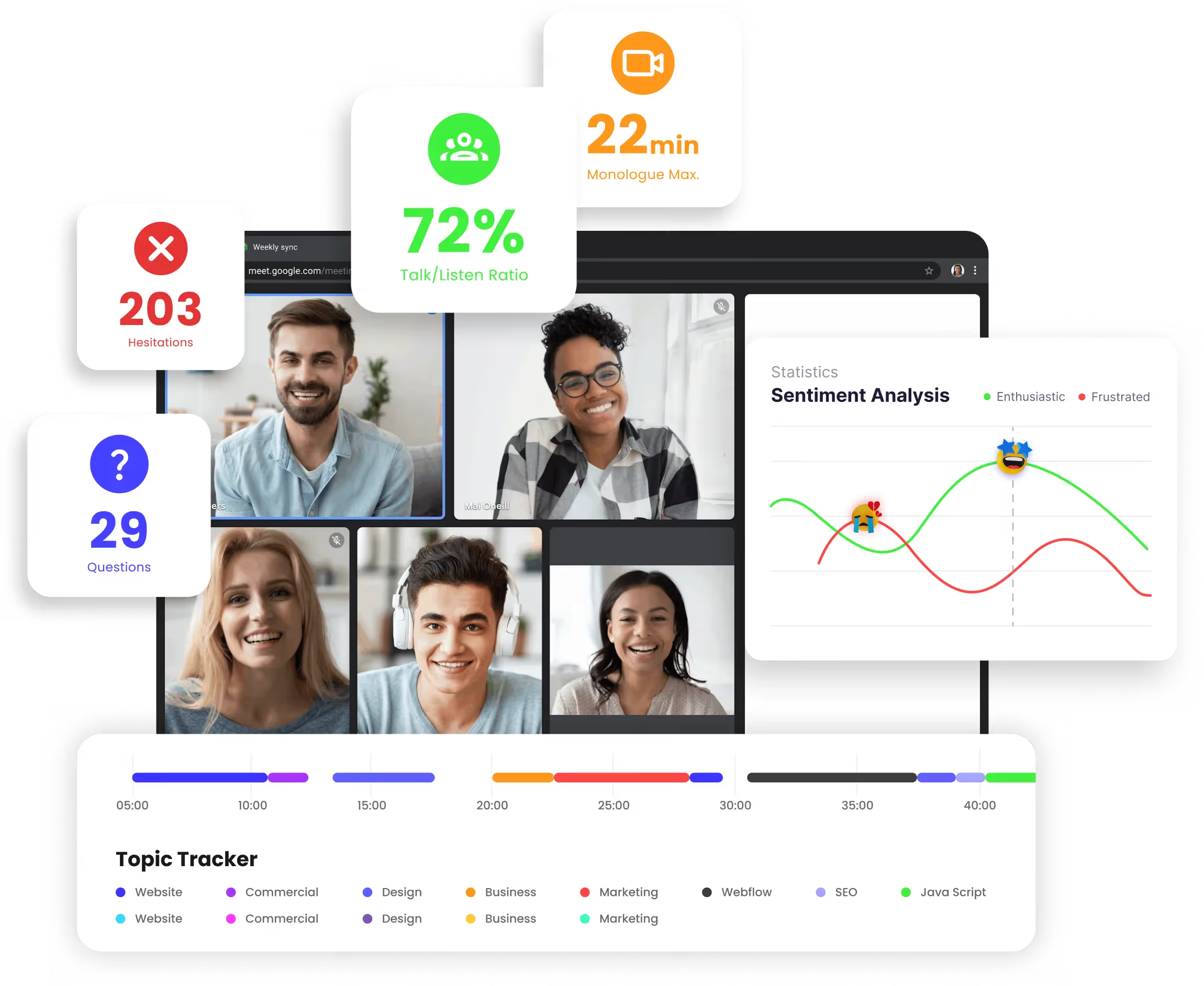
- Coach you or your team on best practices through a dashboard analyzing your performance (sentiment, sharing of speech, language elements...)
- Automatically generate notes and a meeting report.
Do you want to leave nothing to chance in your complex sales? Try Noota for free.
Meet the Writer

FAQ
A complex sale involves multiple criteria making deals harder to close.
- Long sales cycles lasting at least 6 months minimum
- Multiple stakeholders involved in decision-making processes
- Tailor-made solutions requiring buyer collaboration
- High perceived risk and technical expertise needed
Complex sales involve larger organizations with distributed decision-making and risk aversion.
- Multiple stakeholders require extended deliberation periods
- Key accounts fear operational disruption from changes
- Technical integration issues demand expert consultation
- Customization needs extend negotiation timelines significantly
ABM targets specific key accounts with personalized strategies versus broad category prospecting.
- ABM focuses energy on fewer well-chosen accounts strategically
- Traditional methods waste resources on indiscriminate targeting broadly
- Noota's AI meeting notes save 6.4h/week analyzing account intelligence
- ABM with Noota reduces admin by 80% while tracking stakeholder insights
Noota captures and analyzes complex sales meetings with AI-powered insights automatically.
- Records all stakeholder discussions across 80+ languages seamlessly
- Generates actionable notes reducing manual admin work by 80%
- Trusted by 5000+ teams with 4.9/5 G2 rating consistently
- Helps track multiple decision-makers and their specific concerns effectively