EU hosting alone does not shield meeting recordings from the US CLOUD Act when the AI note taker, its cloud host or its model provider falls under US jurisdiction. Under 18 U.S.C. 2713, legal reach follows the provider's control over the data, not the country where the servers sit.
A vendor says "EU data residency". Then you find that its parent company, its transcription API or its language model sits under US law. This guide explains what the CLOUD Act can reach, where it clashes with GDPR and what to ask a vendor. We also say plainly where Noota stands.
How the US CLOUD Act Reaches EU Servers
The Clarifying Lawful Overseas Use of Data Act was enacted on 23 March 2018 (Division V of Pub. L. 115-141). It added 18 U.S.C. 2713, requiring electronic communication and remote computing service providers to preserve, back up or disclose covered data within their "possession, custody, or control", regardless of whether the data is stored inside or outside the United States.
The Act ties disclosure to control, not geography. Recordings stored in Frankfurt, Dublin or Belgium are still within reach if a US company controls the infrastructure or the application.
A US provider can ask a US court to quash or narrow an order that conflicts with foreign law, but a judge decides case by case and nothing is guaranteed. The Act also allows executive agreements with other countries. The UK and Australia have pursued them, and no EU-US agreement is in force.
Why GDPR Article 48 and the Data Privacy Framework Do Not Resolve the Conflict
GDPR Article 48 states that a foreign court or authority decision requiring a personal data transfer is recognized only when based on an international agreement, such as a mutual legal assistance treaty (MLAT). A direct US order served on a provider is not an MLAT.
A provider that operates on both sides of the Atlantic can end up with two conflicting duties: a US order on one side and Article 48 on the other. The EDPB and EDPS set out the European position in their joint response to the European Parliament's LIBE Committee (July 2019).
The EU-US Data Privacy Framework, adopted on 10 July 2023, covers commercial transfers to certified US companies. It does not block US lawful-access demands, and it has been challenged in European courts, so ask your legal team where it stands before you rely on it. Our GDPR guide for AI tools covers the wider rules.
Why EU Hosting Alone Is Not Enough
Many buyers assume that an "EU Data Boundary" or an EU cloud region removes the risk. On 10 June 2025, a French Senate commission asked Anton Carniaux, Microsoft France's Director of Public and Legal Affairs, under oath whether he could guarantee that French citizens' data would not reach US authorities without French authorization. He answered "Non, je ne peux pas le garantir" ("No, I cannot guarantee that") and added that it had not happened to date.
For meeting notes, the exposure goes beyond storage. Your audio passes through four steps, and each one can have a different operator:
- Capture: a meeting bot or desktop app records the audio.
- Speech to text: a transcription service turns the audio into text.
- AI summary: a language model writes the summary and action items.
- Storage: recordings, transcripts and logs sit in cloud storage and connected tools such as a CRM.
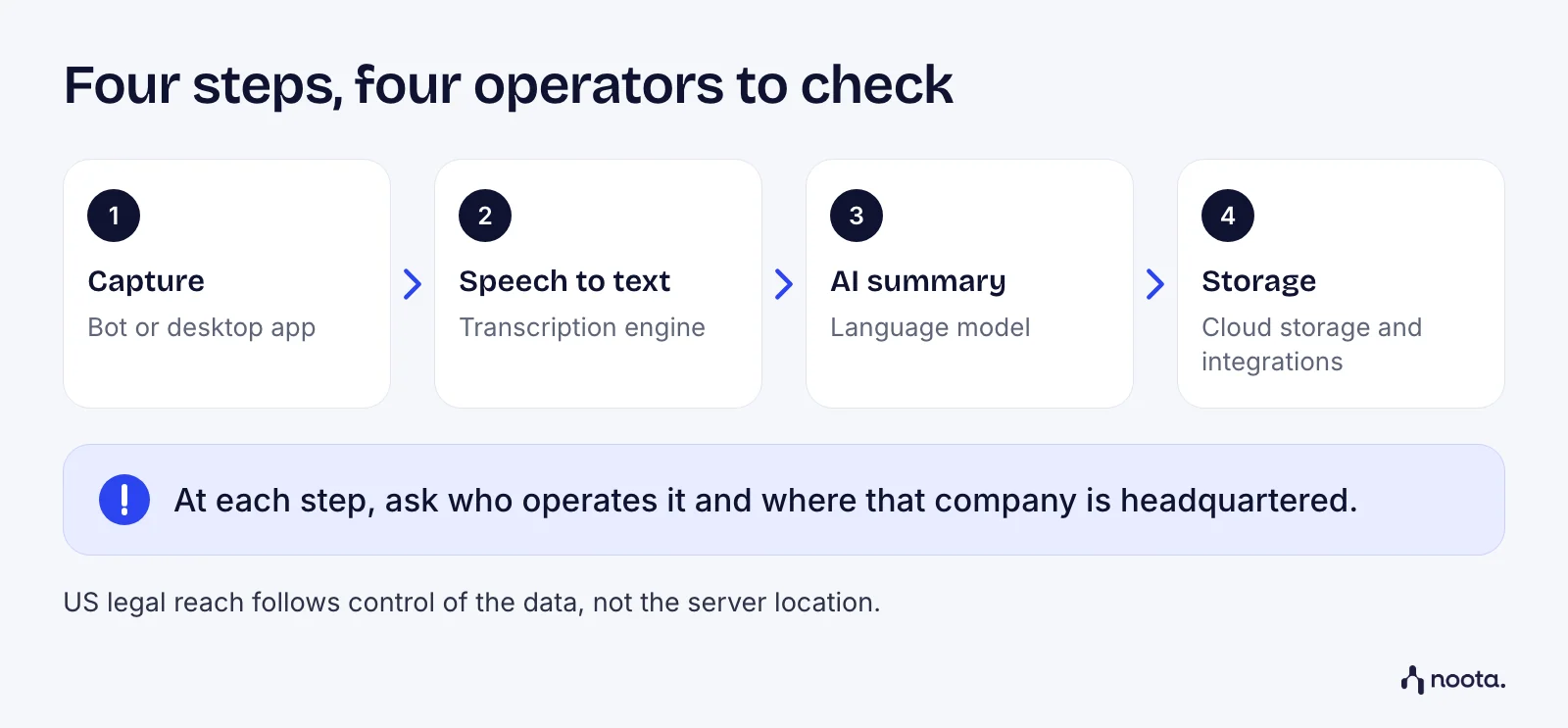
A note taker can store summaries in Frankfurt and still send audio to a US transcription service or text to a US language model. At that point your meeting data is inside a US-controlled pipeline.
Which Technical Controls Actually Reduce CLOUD Act Exposure
Each control below stops one risk and leaves others open.
- Certifications (ISO 27001, SOC 2 Type II): they prove audited security controls. They do not change who controls the vendor, so they do not block a lawful order.
- Encryption and keys: encryption at rest protects against stolen disks, and managing your own keys (BYOK) gives you control over revocation. Neither stops a provider that runs the service and handles plaintext while it processes your audio. Only keys the provider never holds do, and then cloud transcription and summaries stop working.
- Short retention: deleting raw audio right after transcription and capping transcript retention leaves less to hand over, though it cannot erase data that is already under a preservation order.
- An EU-run operator: SecNumCloud, the French ANSSI framework, sets strict EU establishment, governance and ownership requirements. Pairing an EU-owned host with EU-owned models is the most direct way to reduce US parent-company control.
How Noota Limits CLOUD Act Exposure
We are a Paris-based company, founded in 2020. We are ISO 27001 certified, hold a SOC 2 Type II report and apply a no-training commitment to customer meeting data on every plan. As above, those show security controls, not jurisdiction, so what matters here is where your data lives and who operates each step. Our current sub-processor list is public in the Trust Center.
If you need the operator and the models to stay inside Europe, we offer Sovereign France on the Enterprise plan, which suits board, legal, HR, health and public-sector meetings. It runs on Scaleway in Paris, with Mistral models, transcription by Gladia and a capture bot we build and run ourselves. A text-only option keeps no audio or video.
We describe this architecture as compatible with SecNumCloud requirements, and an admin chooses it per workspace. The sovereign AI guide explains the wider approach.
Our standard plans run on Google Cloud in Belgium and the Netherlands. Google is a US-headquartered provider, so choose Sovereign France if US legal reach matters to you. No setup removes every legal risk.
DPA and Sub-Processor Questions to Send Every Vendor
Put these questions in writing before your DPO signs off, and ask for the answers inside the Data Processing Agreement. Our security checklist for AI note takers covers the wider review.
Which company owns and operates the storage, and where is its parent company headquartered?
Which transcription and language-model providers process our audio and transcripts, in which countries, and with what retention?
Does the EU residency promise cover support access, logs, embeddings and backups?
Is raw audio deleted right after transcription, and what is the shortest retention you can configure for transcripts?
Who holds the encryption keys, and can your staff read plaintext for support or abuse review?
What do you do when a non-EU government asks for our data, and will you tell us unless the law forbids it?
Note: This guide is provided for operational and informational purposes and does not constitute formal legal counsel. For binding compliance guidance, consult your legal department or Data Protection Officer (DPO).
Frequently asked questions
No. ISO 27001 and SOC 2 Type II audit security controls such as access management, encryption and incident response. They do not change the corporate jurisdiction of a US-headquartered vendor or cloud operator, so they do not shield stored transcripts from a lawful US order under 18 U.S.C. 2713.
No. The Data Privacy Framework (adopted 10 July 2023) covers commercial data transfers to certified US companies. It does not grant immunity from US lawful-access statutes. DPF certification, SCCs and EU-region hosting are transfer tools, not a jurisdictional shield.
Not automatically. Under 18 U.S.C. 2713, the test is whether the US entity has possession, custody or control over the data. A provider may challenge an order in a US court on comity grounds when it conflicts with EU law, but with no EU-US CLOUD Act executive agreement in force, the outcome is decided case by case and is never guaranteed.
Only if the provider cannot access the plaintext. Provider-managed encryption at rest and standard BYOK (such as AWS KMS or Google Cloud KMS) do not stop a provider that operates the service from decrypting data when served with a valid order. True client-side encryption prevents server-side transcription and LLM summarization.
 Written byAdesh Sonawane